
Table of Contents
- What Affects MiniDV Conversion Costs
- MiniDV Tape Conversion Service Pricing Breakdown
- MiniDV Tape Transfer to USB: Format and Storage Options
- MiniDV Conversion Turnaround Time and Service Options
- DIY MiniDV Tape Conversion vs. Professional Transfer
- Hidden Costs: Shipping, Insurance, and Return Delivery
- Tape Condition, Damage Risk, and Restoration Costs
- Digital File Specifications and Ownership
- Frequently Asked Questions
Last Updated: October 21, 2026
What Affects MiniDV Conversion Costs
The cost to convert mini dv to digital in Australia varies significantly based on several factors that go well beyond a simple per-tape fee. Understanding these variables helps customers make informed decisions about their media preservation project.
The primary cost drivers include tape length, output format selection, storage capacity, service speed, and tape condition. A 60-minute tape costs less to convert than a 120-minute one because it requires less processing time and storage space.
Tape condition matters more than many people realise. Tapes showing visible mould, deterioration, or playback errors require restoration work before digitisation can proceed safely. This adds both time and cost to your project.
The choice between professional conversion and DIY equipment also fundamentally changes your total outlay. Professional services bundle expertise, professional-grade equipment, and quality assurance into a single transparent fee. DIY approaches require upfront hardware investment plus software licenses, with no guarantee of results if your tapes are damaged or degraded.
MiniDV Tape Conversion Service Pricing Breakdown
Professional MiniDV tape conversion pricing in Australia typically follows two models: per-tape flat rates or duration-based pricing. Understanding the difference helps you calculate your true cost before committing.
Per-Tape Pricing Models
Many Australian conversion services charge a fixed price per tape regardless of length. This model works well if your collection contains mostly standard-length tapes (60 or 90 minutes).
According to the research we reviewed, services offering per-tape pricing start at different price points. One provider charges $20 per tape with AI upscaling and enhancement included as standard. Another advertises from $19.95 per tape with multiple output format options available. These flat-rate models simplify budgeting, you know exactly what each tape will cost.
The advantage of flat-rate pricing is predictability. If you have 20 tapes, you multiply the per-tape cost by 20 and know your total. No hidden variables, no surprises at checkout.
Duration-Based Pricing and Add-On Costs
Duration-based pricing ties the conversion fee directly to how much footage is on each tape. This model reflects the actual processing time required and can save money if your collection includes shorter tapes.
Research shows that duration-based services typically charge around $20 for tapes up to 1 hour, $30 for 1-2 hours, and $40 for 2-4 hours. This structure rewards shorter tapes with lower costs while charging proportionally more for fuller ones.
Storage and delivery formats are often priced separately under both models. USB drives come in multiple capacities, 16GB, 32GB, 64GB, and 128GB, each with its own cost. A 16GB USB might cost $10, while a 128GB drive could be $30 or more. This separation means you pay only for the storage you actually need.
| Pricing Model | Base Cost | Best For | Storage Costs |
|---|---|---|---|
| Per-tape flat rate | $19.95-$20 | Standard-length collections | Separate, varies by capacity |
| Duration-based | $20-$40 per tape | Mixed tape lengths | Separate, varies by capacity |
| Bulk discounts | Reduced per-unit rate | Large collections (10+ tapes) | Often included or reduced |
MiniDV Tape Transfer to USB: Format and Storage Options
USB delivery has become the preferred output format for most Australian households because files are immediately playable on modern computers, televisions, and tablets without additional software.
When you choose USB delivery, you’re selecting both the storage device and the digital file format it contains. Most services convert to MP4 format, which offers broad compatibility across devices and platforms.
Storage capacity determines how many hours of video fit on a single drive. A 64GB USB typically holds 8-12 hours of standard-definition video, depending on compression settings.
The relationship between tape length and storage is straightforward: longer tapes require larger drives. A collection of ten 120-minute tapes needs significantly more storage than ten 30-minute tapes. This is why some services charge separately for USB capacity, they’re reflecting the actual storage hardware cost.
Digital file ownership is worth clarifying upfront. When you receive files on USB, they belong entirely to you. You can copy them to cloud storage, external hard drives, or share them with family members.
MiniDV Conversion Turnaround Time and Service Options
Turnaround time directly affects cost in most Australian markets. Standard processing takes longer than express options, and same-day service commands the highest premium.
Same-Day and Express Services
Same-day conversion exists but is typically available only for small orders, usually 1-3 tapes. The cost to convert MiniDV to digital in Australia on an expedited timeline reflects the labour intensity of processing tapes outside normal batch workflows. Showbiz Video Productions offers same-day turnaround in most cases, which means you can drop off tapes in the morning and collect finished files by evening.
Express services (next-day or 2-day turnaround) occupy the middle ground between standard and same-day pricing. They cost more than standard processing but less than true same-day service. This option suits people who need their files quickly without paying premium rates.
Standard turnaround typically runs 5-10 business days. This timeframe allows services to batch-process multiple orders efficiently, keeping per-tape costs lower. If your project isn’t time-sensitive, standard processing offers the best value.
Mail-In and Local Service Models
Mail-in services let you post tapes to the conversion facility, eliminating travel time. You cover return postage and handling, which adds to your total cost. Shipping costs vary by weight and destination, typically ranging from $10-$30 each way depending on your location and the number of tapes.
Local in-person services eliminate shipping costs entirely. You visit a physical location, hand over your tapes, and collect your files on the agreed date. This direct handoff also provides peace of mind, you see the facility, meet the team, and maintain physical custody until the moment of transfer.
For large collections, mail-in services often include return delivery at no extra charge. This reverses the economics: you pay once for outbound postage, and the service covers return shipping. For small orders (1-5 tapes), paying both ways can exceed the conversion cost itself, making local drop-off more economical.
DIY MiniDV Tape Conversion vs. Professional Transfer
The decision between DIY conversion and professional service hinges on equipment costs, technical skill, and risk tolerance. Many people assume DIY is cheaper until they calculate the true total cost.
Equipment and Software Costs for Home Conversion
Converting MiniDV tapes at home requires a MiniDV camcorder or deck (to play the tapes), video capture hardware, and software. A used MiniDV camcorder costs $100-$400 depending on condition. Capture hardware, a USB video capture device or FireWire interface, adds another $50-$200. Video editing or capture software ranges from free (basic options) to $100+ for professional tools.
Your total DIY startup cost easily reaches $200-$600 before converting a single tape. This investment only makes sense if you have dozens of tapes to process and plan to keep the equipment afterward.
Technical knowledge matters significantly. Connecting camcorders to computers, configuring capture settings, and troubleshooting playback issues requires comfort with technology. A single mistake, incorrect video settings, corrupted file, or incompatible software, can waste hours of your time or damage irreplaceable footage.
When Professional Service Saves Money
The cost to convert mini dv to digital in Australia through professional services saves money for most households, especially those with fewer than 20 tapes.
Professional services also handle tape damage gracefully. If a tape has mould, playback errors, or physical deterioration, technicians can often recover the footage or perform restoration work. DIY equipment typically fails silently on damaged tapes, leaving you with corrupted files or no output at all.
Time is another hidden cost of DIY conversion. Processing 30 tapes at home might take 20-30 hours of active work plus troubleshooting. At any reasonable hourly rate, that labour cost exceeds professional service pricing significantly.
Professional services also provide file redundancy and backup. Your converted files are processed, verified, and delivered on stable media (USB or DVD). DIY conversions depend entirely on your own backup discipline, one hard drive failure can erase years of work.
Hidden Costs: Shipping, Insurance, and Return Delivery
The advertised per-tape price is rarely the true total cost. Shipping, insurance, and return delivery add material expenses that many people overlook until invoicing.
Outbound postage to mail your tapes to a conversion facility typically costs $15-$30 depending on the number of tapes and your location. Return postage for your finished files and original tapes costs the same.
Insurance protects your tapes during transit. Many people skip this, assuming postal services are safe, but tapes are fragile, and loss or damage does happen. Insurance typically costs $5-$15 per shipment depending on declared value.
Some services include return delivery in their quoted price; others charge it separately. Always confirm whether your quote includes return postage before committing. The difference can be $20-$40 per order.
For local in-person services, there are no shipping costs, but you invest time in travel. If the facility is 30 minutes away, that’s an hour round-trip per visit. For a single tape, this time cost may exceed the value of avoiding postage.
Tape Condition, Damage Risk, and Restoration Costs
Tape condition directly affects both conversion success and final cost. Tapes stored in poor conditions, high heat, humidity, or dust, degrade over time, and some may be unplayable without restoration.
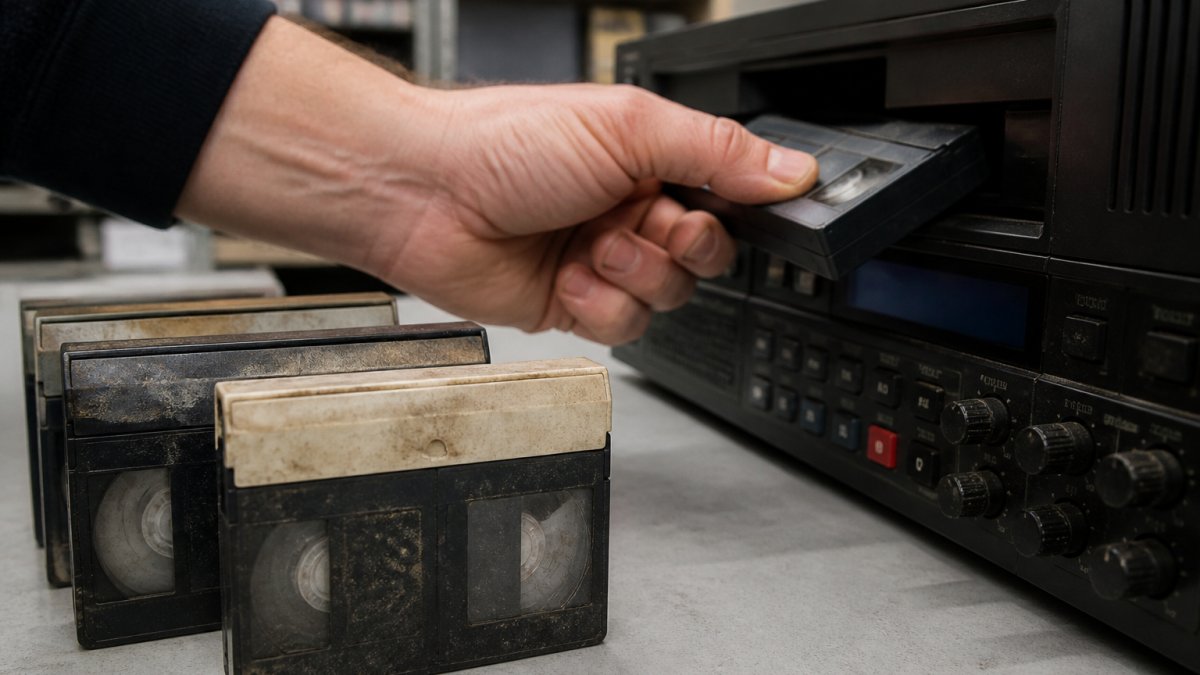
Visible mould, tape brittleness, or playback errors signal deterioration. Professional services inspect tapes before conversion and flag problematic ones. Basic conversion proceeds at standard rates for healthy tapes.
Restoration costs vary widely depending on damage severity. Minor mould or dust cleaning might add $5-$15 per tape. Serious damage requiring professional tape repair or data recovery can cost $30-$50 per tape or more.
The risk of data loss is real. Tapes stored in attics, basements, or garages for 20+ years often suffer from humidity and temperature fluctuations. Delaying conversion increases the risk that footage becomes permanently unrecoverable.
Digital File Specifications and Ownership
Most Australian conversion services deliver MP4 files, the industry standard for consumer video. MP4 is compatible with Windows, macOS, iOS, Android, and most smart televisions.
File resolution depends on your source tape and the conversion equipment. MiniDV tapes contain standard-definition video (720×576 pixels in PAL format, the Australian standard).
Frame rate is typically 25 fps (frames per second), matching the PAL standard. This is standard for Australian video and plays correctly on all modern devices.
Bitrate (the amount of data per second) affects file size and quality. Higher bitrates produce larger files with better quality; lower bitrates compress more aggressively.
You own the digital files outright. There’s no licensing restriction, no subscription, no ongoing dependency on the conversion service.
Converting your MiniDV tapes to digital is one of the most effective ways to preserve family memories before degradation becomes irreversible.
Frequently Asked Questions
How much does professional MiniDV tape conversion typically cost?
Professional MiniDV conversion costs depend on tape quantity, duration, output format, and whether you choose standard or same-day service. Per-tape pricing varies across providers; some charge a flat rate while others base costs on tape length. Additional fees apply for USB storage, DVD output, or digital file delivery. Visit your chosen provider’s pricing page or request a quote for transparent costs tailored to your collection size.
Is it cheaper to convert MiniDV tapes yourself or use a professional service?
DIY conversion requires purchasing or renting a MiniDV camcorder or deck (often $50-$300+), capture software, and storage media, plus your time. For small collections (5-10 tapes), DIY may seem cheaper upfront; for larger collections, professional services typically cost less overall and eliminate equipment hassle. Professional services also protect irreplaceable footage from handling damage and offer quality assurance.
What digital format should I choose for converted MiniDV footage?
MP4 is the most widely compatible format for playback on modern devices, TVs, and computers. USB delivery offers convenience and portability; DVD suits those without modern playback devices.
How long does professional MiniDV tape conversion take?
Turnaround time varies by provider and service tier. Same-day or express services typically handle small batches within hours; standard services may take 5-10 business days depending on queue and collection size. Mail-in services add shipping time both ways. Confirm turnaround before ordering, especially if you need footage for an upcoming event or deadline.
What happens if my MiniDV tapes are damaged or show mould?
Professional services assess tape condition before transfer. Minor surface mould or tape damage can often be cleaned and transferred successfully, though quality may vary. Severely deteriorated tapes risk incomplete or failed transfer. Some providers offer restoration or enhancement services at additional cost. Discuss your tapes’ condition upfront; many providers offer free assessments or consultations.