
Last Updated: October 28, 2026
Quick Summary
Unconverted old film reels slowly deteriorate because film is a chemical medium that reacts to heat, humidity and handling. Damage such as fading, brittleness, mould and vinegar syndrome is often irreversible, so converting old film reels to digital before they degrade further is the safest course.
- Film deteriorates gradually, and reels that still play can already be brittle.
- Keep storage below about 20°C with relative humidity between 30% and 50%.
- A vinegar smell when opening a case signals acetate breakdown; isolate that reel immediately.
- Handle film only by its edges and never force a stuck reel free.
- Prioritise reels with active damage and irreplaceable footage for conversion first.
Table of Contents
- Why Old Film Reels Need Attention Now
- How Film Deteriorates Over Time
- Vinegar Syndrome Film Symptoms to Watch For
- How to Store Old Film Reels Safely Until Transfer
- DIY Transfer Versus Professional Conversion
- Cost of 8mm Film to Digital Transfer
- Booking Your Film Reels for Digital Transfer
- Frequently Asked Questions
Why Old Film Reels Need Attention Now
Old 8mm and Super 8 film reels are not a permanent archive. Families may assume their reels will last indefinitely in a cupboard, only to find the film has changed by the time they finally pull it out. Film is a chemical medium, and it responds to its environment every day it sits in storage.
The real question is what happens if you leave those reels unconverted. The short answer is that film deteriorates gradually, and the damage is often irreversible. The longer answer depends on how the reels have been kept, which is why storage conditions matter as much as age.
One point is worth stating clearly: deterioration is a risk, not a certainty. Film does not usually fail overnight. It declines over time, and the speed of that decline depends on heat, humidity and handling. National Film and Sound Archive of Australia guidance on film preservation
How Film Deteriorates Over Time
Film deterioration is a slow chemical process. The base and the image layers both age, and once that process is underway it tends to continue. Understanding the main forms of damage helps you decide how urgently a reel needs attention.
Fading, Shrinkage and Brittleness
Colour film is particularly vulnerable. The dyes that form the image can fade unevenly, which shifts colours and reduces contrast. Over time the base can also shrink and become brittle, making the reel harder to run through a projector or scanner without tearing.
ARS Video notes that film fades over time depending on how it has been kept, and that water and humidity are particular threats. This means two reels of the same age can look very different after decades. A reel kept in a cool, dry room is usually in far better shape than one stored in a damp garage.
A common mistake is assuming that a reel which still plays is safe. Brittleness is often invisible until the film snaps during threading.
Mould and Water Damage
Mould is one of the most serious threats to film. It grows in humid conditions and can spread across the image and the base, leaving marks that cannot be fully removed. Water damage from flooding or a leaking roof can cause similar harm, and it is especially common in older homes on the Gold Coast where humidity is high for much of the year.
If you find mould, do not attempt to scrub it off yourself. Handling a mouldy reel can spread spores and worsen the damage. Keep the reel isolated and seek professional advice promptly.
Vinegar Syndrome Film Symptoms to Watch For
Vinegar syndrome is a form of chemical breakdown in acetate-based film. The name comes from the sharp, vinegar-like smell released as the base degrades. It is one of the clearest warning signs that a reel needs urgent attention.
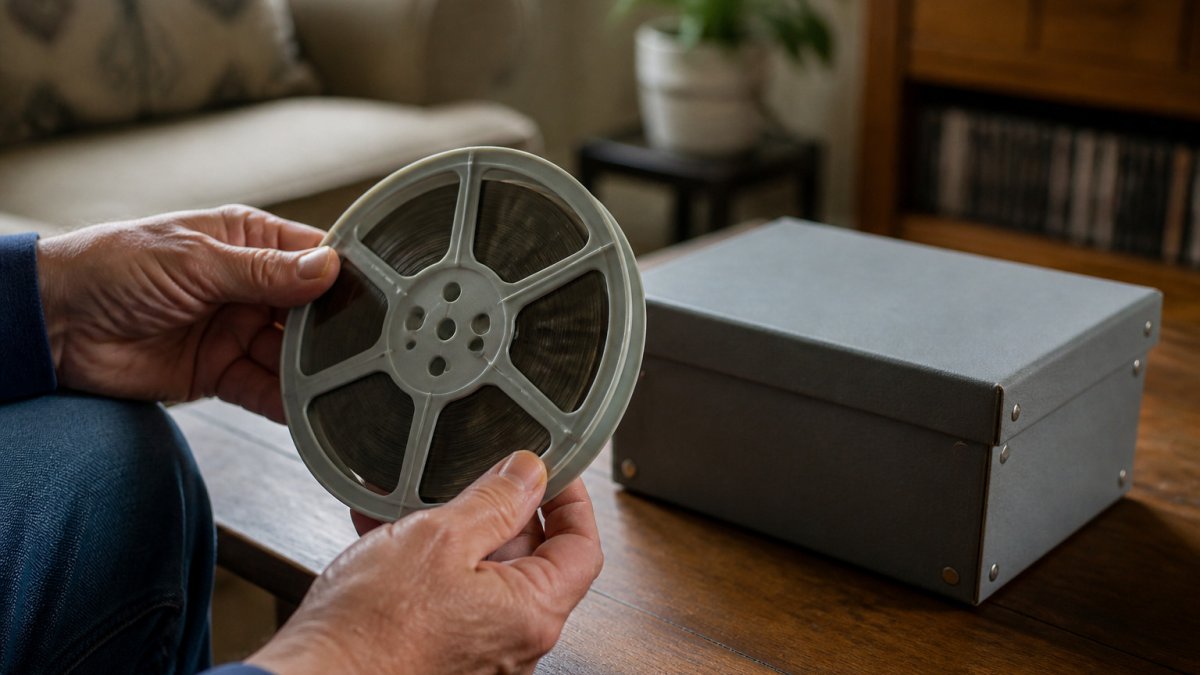
Look and smell for these symptoms:
- A distinct vinegar odour when the reel case is opened
- Film that feels sticky, curled or warped
- Cracking, bubbling or a crumbly texture on the base
- Shrinkage that makes the film hard to run through equipment
Vinegar syndrome is not reversible, but its progress can be slowed by cool, dry storage and by separating affected reels from healthy ones. Because the smell can spread to nearby material, it is wise to isolate any reel showing these signs.
How to Store Old Film Reels Safely Until Transfer
Good storage buys you time, but it does not stop deterioration. The aim is to slow the chemical processes described above until the reels can be converted. Most practitioners find that stable conditions matter more than any single ‘perfect’ number, because film reacts to swings in temperature and humidity as much as to absolute levels.
What ‘cool and dry’ actually means
Film archivists generally aim for a stable, cool environment with moderate-to-low humidity. As a practical rule of thumb for a home collection:
- Keep the storage space below about 20°C if you can, and avoid anywhere that regularly exceeds 25°C.
- Aim for relative humidity in the 30-50% range. Above roughly 60%, mould and vinegar syndrome accelerate; below about 30%, acetate film can become brittle.
- Prioritise stability over perfection. A cupboard that sits at a steady 22°C is usually safer than a shed that swings from 8°C to 35°C across a year.
Attics, sheds and garages can be exposed to seasonal temperature and humidity swings.
Container and shelving choices
- Keep reels in their original cases where the cases are clean and intact, or move them to acid-free, inert plastic (such as polypropylene) containers.
- Avoid PVC cases and cardboard that has absorbed moisture or shows foxing; both can off-gas or harbour mould.
- Store reels upright on shelves, like books, rather than stacked flat under weight. Stacking compresses the edges and can worsen warping.
- Keep reels away from direct sunlight, heaters, hot water systems and external walls that condense moisture.
- Label each reel with its contents and any visible damage so you can prioritise later.
Handling rules that prevent avoidable damage
- Handle film by the edges only, with clean, dry hands or lint-free gloves. Finger oils and salts are acidic and can etch the emulsion over time.
- Never pull a stuck or stiff reel free. If a reel will not turn freely, stop and seek advice, forcing it is a common way to snap brittle film.
- Keep mouldy reels isolated in a sealed container and do not handle them alongside healthy reels.
- Do not ‘clean’ film with household products, alcohol or water. Amateur cleaning can strip emulsion or spread mould.
If you can smell vinegar when you open a case, isolate that reel immediately. The odour indicates acetate breakdown, and the affected reel can accelerate deterioration in nearby film if stored together.
A simple triage method when time or budget is limited
If you cannot convert everything at once, prioritise in this order:
- Reels showing active damage, vinegar odour, mould, warping or brittleness. These are deteriorating fastest and are the most urgent.
- Unique or irreplaceable footage, the only copy of a wedding, a family member who has passed, or an event that cannot be recreated.
- Older formats and colour film, colour dyes fade and early formats are often more fragile.
- Bulk or duplicate reels, leave these until the higher-priority material is safe.
National Film and Sound Archive of Australia guidance on film preservation
DIY Transfer Versus Professional Conversion
Some people consider converting reels themselves using a home projector and a camera or a consumer film scanner. This carries trade-offs that are worth understanding before you decide.
What DIY actually involves
The common home methods are:
- Projection and re-filming, projecting the film onto a screen or wall and recording it with a phone or camera. This is the cheapest option, but it introduces flicker, keystone distortion, uneven focus and colour shift, and it requires a working projector and a dark room.
- Consumer film scanners, dedicated devices that feed the film past a sensor. Quality varies widely, and many consumer units handle only specific formats (often 8mm and Super 8, sometimes 16mm) and struggle with damaged or spliced film.
- Frame-by-frame capture rigs, a projector or viewer combined with a camera and macro lens. These can produce good results but require significant setup time, patience and some technical skill.
The trade-offs, honestly stated
| Factor | DIY | Professional conversion |
|---|---|---|
| Upfront cost | Lower, but equipment and time add up | Higher per reel, but no equipment outlay |
| Time | Often many hours per reel once setup and editing are counted | Usually days, not weeks, depending on the service |
| Image quality | Variable; flicker, focus and colour are hard to control | Controlled lighting, frame rate and colour correction |
| Risk to fragile film | Higher, jams, snags and mishandling can tear brittle or spliced film | Lower, trained handling and dedicated scanners |
| Formats and splices | Consumer gear may not handle 16mm, splices or damaged perforations | Professional scanners generally handle mixed formats and repairs |
| Output | Often a single video file; audio and editing may need separate work | Usually delivered in a chosen format, sometimes with cleaning and basic correction |
The specific risks of DIY on old film
A common pattern is for a family to attempt a DIY transfer, damage one reel, and then bring the rest in for professional conversion. If your reels show brittleness, mould, vinegar syndrome or old splices, professional conversion is the safer choice, because the risk of losing material during a DIY attempt is high.
When DIY is reasonable
DIY can be a sensible option when:
- You have a small number of reels in good condition with no visible damage.
- The footage is duplicated elsewhere and the reels are not the only copy.
- You are comfortable with the equipment and prepared to accept lower image quality.
- You treat it as a learning project rather than an archival preservation step.
When to choose professional conversion
Choose professional conversion when the footage is irreplaceable, when the reels show any signs of damage, when you have a mix of formats including 16mm, or when you need a reliable, watchable result without spending days on setup. It is also the better route if you want the reels cleaned and inspected as part of the process, since a professional can flag problems that a home setup would simply run through and worsen.
Digitisation is not the end of the job. Whichever route you choose, keep more than one copy of the resulting files, store them on separate devices, and plan to migrate them to new media every few years, digital files are not immune to loss either.
Cost of 8mm Film to Digital Transfer
Pricing depends on the collection and service details. Showbiz Video Productions provides current pricing on its website, and you can request a quote for your collection.
Booking Your Film Reels for Digital Transfer
At Showbiz Video Productions, same-day service is available in most cases. If you are ready to have your reels converted, request a quote today.
Frequently Asked Questions
Can old film reels expire?
Film does not expire in a single moment, but it deteriorates gradually. Heirloom.cloud notes that film declines over time rather than failing overnight. How quickly this happens depends heavily on how the reels have been kept. ARS Video identifies water and humidity as particular threats.
What are the signs that my film reels are deteriorating?
Look for a vinegar smell, colour fading, a brittle or curled edge, shrinkage, cracked or lifting splices and any visible mould. Heirloom.cloud lists these as possible risks. Mould is especially serious because it can spread to neighbouring reels. If you notice any of these signs, keep the reel away from other media, avoid playing it on equipment that may tear it, and arrange a professional assessment before attempting any transfer yourself.
Can old film reels be repaired if they are brittle?
Some brittle reels can be handled carefully and transferred, but severely brittle film may tear during playback or scanning. Heirloom.cloud warns that deterioration can affect how safely a reel can be run through equipment. A professional assessment helps determine whether a reel can be converted as it is or needs specialist handling first. Avoid forcing a stiff reel onto a projector, as this often causes further damage.
How much does it cost to get 8mm film digitised?
Showbiz Video Productions publishes current prices on its website. Compare the full scope of each quote rather than only the headline rate per reel.
