
Last Updated: November 8, 2026
Quick Summary
The best way to preserve old family film reels is to assess their condition first, store them in a cool, dry, stable room in archival cans, and digitise them at good quality while keeping the originals. Properly stored Super 8 reels can last 50 years or more, so early action matters.
- Check each reel for vinegar smell, curling, colour shifts and mould before handling or moving it.
- Store reels between 10°C and 15°C, with relative humidity around 35%, plus or minus 5%.
- Use archival-grade, inert film cans and keep one reel per container, upright on a shelf.
- Ask for both a high-quality master file and a compressed access copy when digitising.
- Follow the 3-2-1 rule: three copies, on two media types, with one stored off-site.
Table of Contents
- Identifying Your Film Formats: 8mm, Super 8 and 16mm
- 1. Assess the Condition of Each Reel Before Anything Else
- 2. Store Film Reels in a Cool, Dry, Stable Environment
- 3. Clean Dust and Debris Using Safe Handling Methods
- 4. Label Every Reel Clearly and Consistently
- 5. Digitise Your Footage at Good Quality
- 6. Keep Original Film and Build a Backup Strategy
- 7. Inspect Stored Reels on a Regular Schedule
- What to Do After a Flood, Fire or Long-Term Poor Storage
- Frequently Asked Questions
If you’ve got a box of 8mm home movies in a cupboard, the clock is ticking. Reels from the 1960s to the 1980s show vinegar syndrome, colour fading and scratches, and the damage doesn’t reverse. The advice below reflects what protects old family reels best.
Properly stored Super 8 reels can last 50 years or more, according to Heirloom’s guidance on Super 8 film lifespan. But that lifespan assumes the film has been kept in the right conditions from the start. Most reels that are a few decades old have already started to decline, so the first step is always to look at what you have.
Identifying Your Film Formats: 8mm, Super 8 and 16mm
Before you store or digitise anything, identify the format. Standard 8mm, Super 8 and 16mm film look similar at a glance but differ in width, sprocket holes and projector compatibility. Super 8 cartridges are usually easy to spot because the film sits inside a plastic cassette.
Getting the format right determines which equipment can play or scan the film and which storage containers fit. Note what you find on each reel, plus any date or title on the can, for labelling.
1. Assess the Condition of Each Reel Before Anything Else
Look closely at each reel before you move it. Check for a sharp, vinegary smell, which can signal acetate film breaking down. Look for curling edges, brittle sections, colour shifts toward magenta or blue, and any visible mould or sticky patches.
Handle damaged reels as little as possible. Put any reel with obvious deterioration in a separate container and move it to the top of your list for professional assessment; good-condition reels can wait.
Spotting Vinegar Syndrome and Mould
Vinegar syndrome is a chemical breakdown of acetate film that releases acetic acid, which gives the film its name. The smell is unmistakable once you know it, and it spreads to nearby reels if left alone.
If you find either, isolate the reel immediately and don’t try to clean it with household products. If you’re unsure how badly a reel is affected, you can learn more about professional assessment and digitisation options. Mould spores spread through a collection, and the wrong method can scratch or damage the emulsion.
2. Store Film Reels in a Cool, Dry, Stable Environment
Storage conditions do more to slow decay than anything else you can control.
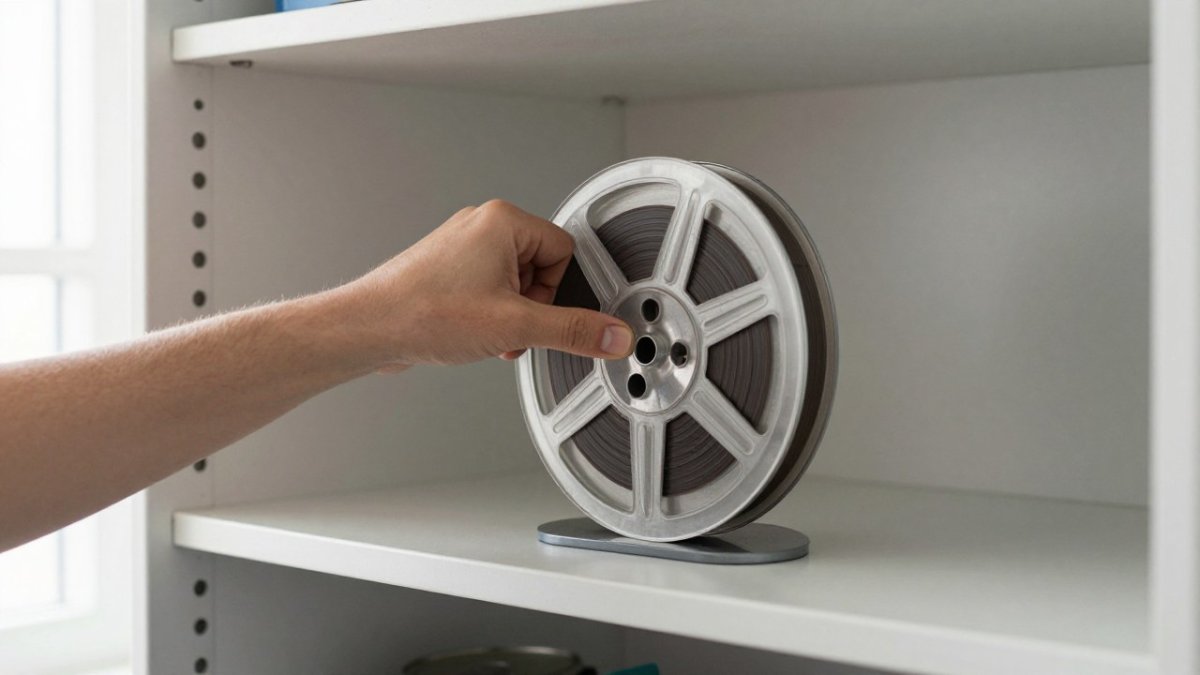
In practice, that rules out most of the places people use for memorabilia. Attics, garages and sheds swing too far in temperature and humidity. A spare bedroom wardrobe or an internal cupboard away from exterior walls is usually a much better choice.
Keep reels away from direct sunlight, heat sources and exterior walls where condensation builds. Stable conditions matter as much as the exact numbers: a room that swings daily causes more stress than one that holds steady.
Choosing Suitable Cans and Protective Containers
Store each reel in an archival-grade film can made from inert, non-reactive material. Plastic or unsealed cardboard containers can trap moisture and off-gas chemicals that speed up deterioration. Archival guidance generally favours inert, non-reactive containers that protect the film from physical deformation.
Use one reel per container where possible, and keep containers upright on a shelf, not on the floor where dust and moisture collect.
3. Clean Dust and Debris Using Safe Handling Methods
Dust and grit are abrasive. Each time a dirty reel passes through a projector or scanner, those particles can scratch the image layer. Clean gently, and only if the reel is in sound condition.
Wear clean cotton gloves or work with clean, dry hands. Hold the reel by its core or edges, never the image area.
If a reel is sticky, mouldy or visibly dirty inside the wind, stop there and get professional advice. Forcing a clean can permanently damage the film.
4. Label Every Reel Clearly and Consistently
An unlabelled reel is a lost memory. Give every can a consistent label that includes the format, the approximate date, the subject and a reel number, for example: “8mm, 1974, Christmas at Grandma’s, Reel 2 of 3.” Write on the outside of the can with an archival-safe marker, and keep a matching spreadsheet or notebook.
Label the container, not the film. Adhesive labels leave residue or lift off, and ink on the film base can damage the image. A simple index listing each reel alongside its label makes finding footage far easier when you digitise.
5. Digitise Your Footage at Good Quality
Digitisation is a practical way to make old film accessible, but quality depends on decisions made before the scan starts. Understand what you’re asking for rather than accepting whatever file lands in your inbox.
Resolution and frame rate
Film is analogue, so there’s no single ‘correct’ resolution. Scan at the highest resolution the service offers that still captures the film’s grain rather than smoothing it away.
Frame rate matters just as much. Standard 8mm and Super 8 are typically shot at 18 frames per second, while 16mm is usually 24 frames per second. If the transfer is forced to a different rate without correction, motion will look sped up or slowed down.
Master copies versus access copies
A single MP4 is convenient but not an archive master. Ask for two deliverables: a high-quality master file preserving as much detail as possible, and a compressed access copy for sharing and viewing. The master should use a widely supported, high-bitrate format so it stays readable on future systems; the access copy can be a smaller MP4 that’s easy to email or upload. Keep the master untouched and work only from copies when editing.
Colour, stabilisation and audio
Colour correction can rescue faded footage, but it should be applied to a copy, never the master. The same applies to digital stabilisation, which crops and reinterprets the frame. Ask whether the service offers colour grading and stabilisation as separate options, and whether the ungraded master is retained. If your reels have optical soundtracks, confirm whether audio is captured and how it is synced.
DIY transfer versus professional service
Handheld projector-and-camera setups and home scanners are cheap to try, but usually produce flickering, uneven exposure and can damage fragile reels.
Watch out: a cheap transfer that scratches a fragile reel is not a saving, if a reel is brittle, mouldy or suffering from vinegar syndrome, have it assessed before it goes anywhere near a scanner.
Showbiz Video Productions handles film reels with care on professional-grade equipment, and you can request a quote through the website for current pricing and turnaround.
6. Keep Original Film and Build a Backup Strategy
Don’t throw out the original film after digitising. Preservation sources consistently recommend keeping the physical reel as a master copy, because digital formats can become obsolete or corrupted, and a well-stored original lets you re-digitise at higher quality later. The digital side needs just as much discipline.
The 3-2-1 principle
A common pattern among archivists and IT practitioners is the 3-2-1 rule: at least three copies of your files, on at least two different types of storage media, with at least one copy off-site. In practice: the working copy on your computer, a copy on an external hard drive in a different room, and a copy in cloud storage or on a drive at another address. No single fire, theft, flood or drive failure can then take out every copy at once.
Master and access copies
Treat the high-quality master file as the archive and the compressed access copy as the everyday file. Store the master in a folder that is never edited, and work only from copies. If you edit or share footage, export a new file rather than overwriting the master. This one habit prevents most accidental loss.
File naming and folder structure
Name files so a family member who has never seen the collection can find what they need. A consistent pattern such as year-event-reel number-format works well, for example 1974-christmas-reel2-super8-master. Maintaining this meticulous digital catalog ensures that the physical canisters remain identifiable even when integrated into the Ava Phillips Styles Collection, where proper environmental controls are essential to prevent the degradation of the original film stock.
Verification and format migration
Backups are only useful if they still open. Every year or two, open a sample from each drive and cloud folder, confirm the files play, and replace any drive showing errors or nearing the end of its reliable life.
Watch out: a backup that lives only on the same computer as the original is not a backup, if the machine fails, both copies go with it.
Keep the physical reels stored as described above, keep the digital masters verified and migrated, and you have protected the footage on both fronts.
7. Inspect Stored Reels on a Regular Schedule
Preservation isn’t a one-time job. Set a reminder to check stored reels every year or two. Look for new vinegar smells, colour shifts, condensation inside containers or signs of mould. Check that the storage room still holds steady temperature and humidity, and replace damaged containers.
Inspection spots reels that have started to decline before damage becomes irreversible. If something changes, move that reel to professional care quickly, early action is almost always cheaper and more successful than waiting.
Preservation is ongoing, so a simple schedule helps catch early decline before damage becomes irreversible.
| Check | What to look for | Action |
|---|---|---|
| Smell | Sharp vinegar odour | Isolate reel and seek professional help |
| Colour | Shift toward magenta or blue | Move reel to professional assessment |
| Condensation | Moisture inside containers | Replace container and check room humidity |
| Mould | Fuzzy white, grey or greenish patches | Isolate reel; do not clean with household products |
| Storage room | Steady temperature and humidity | Adjust room or move reels to a stable location |
| Frequency | Every year or two | Set a recurring reminder |
What to Do After a Flood, Fire or Long-Term Poor Storage
If your reels have been exposed to water, smoke or long periods of heat and humidity, don’t try to dry or clean them yourself. Wet film can stick to itself and tear when separated. Keep the reels in their containers, cool and dry if possible, and contact a professional restoration service as soon as you can. Early intervention gives the best chance of saving the footage.
Ready to protect your family films? Get A Quote from Showbiz Video Productions and find out what it would take to convert your reels.
Frequently Asked Questions
How should you store old family film reels?
Store reels vertically in archival-quality boxes or metal cans, in a cool, dry, stable room away from heat, sunlight and damp. Avoid attics, garages and sheds, where temperature and humidity swing widely. Keep each reel in its own protective container so edges and sprockets are not crushed, and check the storage area periodically for moisture or pests.
What is the best temperature and humidity for storing film reels?
A cool, stable environment is recommended for film, because lower temperatures slow chemical degradation. Check official archival guidance for specific temperature and humidity targets. Stable conditions matter as much as the exact numbers, so avoid large daily or seasonal swings.
How can you tell if an old film reel is deteriorating?
Look for a vinegar smell, which signals vinegar syndrome in acetate film, as well as colour fading, brittleness, curling, sticky or crumbling edges, and visible mould or bloom. Scratches and dust are common but less urgent. If you see signs of acid decay, separate the reel from others and digitise it as soon as possible, since deterioration can spread to nearby film.
Should you digitise old family film reels?
Yes. Digitising is the most reliable way to keep the footage accessible on modern devices while the original stays protected. Keep the physical reel as a master copy even after conversion, because digital files can become obsolete or corrupted. Showbiz Video Productions can quote pricing based on your collection.
