
Table of Contents
- Why Choose an Alternative to FilmCopyCentre for Digitising Memories
- VHS to Digital Conversion: What You Need to Know
- Film Reel to Digital Conversion Services Compared
- Family Video Digitising: Turnaround, Pricing, and Quality
- Digital File Formats for Video Backups: Which Format Matters
- Handling, Privacy, and Preservation of Your Original Media
- DIY Digitisation Versus Professional Transfer Services
- Conclusion: Finding the Right Service for Your Family Memories
- Frequently Asked Questions
Last Updated: October 4, 2026
Why Choose an Alternative to FilmCopyCentre for Digitising Memories
When searching for digitising memories alternatives like a filmcopycentre option, you’re facing aging VHS tapes, film reels, and cassettes with no way to play them on modern devices. The question is whether you’re getting the right service for your irreplaceable family moments.
Not all digitisation services approach your media the same way. Some prioritise speed over quality, others charge hidden fees, and some treat originals carelessly. The best services balance quality, transparency, and genuine care for your media.
This guide covers what matters when choosing a digitising memories alternative: format support, hidden costs, turnaround time, and quality expectations.
VHS to Digital Conversion: What You Need to Know
VHS to digital conversion quality depends entirely on equipment and expertise. Professional-grade equipment preserves detail, colour accuracy, and sound that budget converters miss.
Professional services handle tape degradation with cleaning protocols and specialised playback equipment designed to read compromised tapes without further damage. Budget services skip this step.
Understanding tape condition and what services will accept
Assess tape condition before sending them. Professional services grade tapes and determine whether digitisation is possible and what recovery methods are needed.
Signs your tape may have problems:
- Visible mould or discolouration on the cassette shell or visible through the window. Mould indicates moisture exposure and can spread during playback.
- Sticky shed syndrome, where the tape feels tacky or gummy when you touch it. This happens when the binder holding oxide to the tape base breaks down, usually from heat and humidity. A professional service can sometimes recover this with controlled playback and humidity management, but it’s a red flag.
- Warping or deformation of the cassette itself. If the plastic shell is warped, the tape inside may not wind evenly, causing playback errors or jamming.
- Severe picture breakup or audio dropout when you try to play it. This suggests oxide loss or tape damage that may or may not be recoverable depending on how much of the footage is affected.
- Loose or tangled tape inside the cassette. If you can see tape spooled incorrectly through the window, the service will need to carefully rewind it before digitisation.
Most professional services accept tapes in poor condition, but some have limits. Tapes that won’t play or show severe picture breakup may not be recoverable. The best services assess tapes upfront and explain honestly what’s salvageable.
Media format support and mixed collections
Format support matters equally. Standard VHS is most common, but variants like VHS-C (camcorder), VHS-LP (long play), Hi-8, Video8, Betamax, and U-matic require different handling. Not all services support all formats.
If your collection is mixed, choose a service that covers all formats in one place. Digitising across multiple services results in inconsistent colour grading, audio levels, and file formats.
Professional playback and recovery techniques
Professional digitisation involves inspection and cleaning, controlled playback on professional-grade VCR equipment with real-time adjustments, simultaneous video and audio capture at full resolution (720×480 NTSC or 720×576 PAL), quality monitoring with re-capture if needed, and return of originals in the same or better condition.
Consumer converters skip these steps, offering no real-time adjustment, quality monitoring, or recovery options, resulting in noticeably lower quality especially on degraded tapes.
Showbiz Video Productions handles VHS, VHS-C, Hi-8, and other formats in one place with professional-grade equipment.
Film Reel to Digital Conversion Services Compared
Film reels (8mm, Super 8, 16mm) require completely different equipment than VHS, a film scanner or projector-based system that captures each frame individually.
Quality differences are enormous. Cheap conversions use a camera pointed at a projected image. Professional services use film scanners that read each frame directly, preserving colour, detail, and authenticity.
When comparing film services, ask about frame rate, colour correction, and gauge support (8mm, Super 8, 16mm). Not every service handles all formats.
| Service Type | Best For | Key Consideration |
|---|---|---|
| Budget online services | Small collections, non-critical footage | Lower quality, longer wait times |
| Local professional services | Mixed formats, urgent turnaround | Higher cost, but faster and more careful |
| Specialist film-only services | Large film collections | Single-format focus, may not handle video |
| Full-service providers | VHS, film, cassettes, vinyl all together | Consistent quality, one-stop solution |
Family Video Digitising: Turnaround, Pricing, and Quality
Families prioritise turnaround time, cost, and quality. These rarely align perfectly, fast and cheap usually means poor quality. Understanding trade-offs helps you choose what matters most.
Transparent pricing and how to calculate true cost
Many services advertise low per-tape prices but add charges for expedited processing, custom formats, USB delivery, damaged media handling, colour correction, minimum orders, and shipping. A transparent service lists these upfront.
Ask about base pricing (per-tape cost, minimum order, degraded media surcharges), format and delivery (included formats, custom format costs, delivery fees), and turnaround (standard time, rush options, seasonal delays).
Example cost comparison:
Suppose you have 15 VHS tapes in mixed condition and want MP4 files on USB, delivered within one week.
Service A advertises $5/tape but adds $10 USB delivery and $5 degraded tape handling = $90 total. Service B advertises $8/tape all-inclusive = $120 total.
Turnaround times: What to expect and what affects delays
Same-day service can be genuine if the service has equipment and staff, offering real advantage when you’re nervous about handing over irreplaceable media.
Most services take 1-2 weeks for standard turnaround. Actual digitisation is fast (30 minutes to an hour per tape), but delays come from backlog and queue waiting.
Turnaround depends on collection size, tape condition, seasonal demand (busier Nov-Dec and May-June), service capacity, and delivery method (cloud download is faster than USB).
Delivery options: courier/mail (2-5 days, $10-30), local pickup (fastest, often free), cloud download (instant, requires file management), USB/external drive (slower, tangible backup). Local? Ask about pickup. Interstate/international? Cloud download is fastest.
Quality and file formats: What you’re actually getting
When your videos come back to you, they’ll be in a specific file format and resolution. This matters more than most people realise.
Common formats and their strengths:
- MP4 (MPEG-4 video codec H.264). The safest choice. Plays on nearly everything: TVs, computers, tablets, phones, streaming services. File sizes are moderate, and quality is good for archiving and sharing. Most services default to MP4.
- MOV (Apple QuickTime). Works well on Apple devices and some editing software. Less compatible with Android and some older TVs. Often used by services targeting Mac users.
- AVI (Audio Video Interleave). Older format, larger file sizes, less compatible with modern devices. Rarely recommended unless you have a specific reason to use it.
- MKV (Matroska). Technically superior, supports multiple audio and subtitle tracks, excellent for archiving. Plays on fewer devices without extra software. Useful if you plan to edit or if you want maximum flexibility, but not ideal for casual playback.
- ProRes (Apple ProRes). Professional format used in video editing. Large file sizes, excellent quality, overkill for most families unless you plan to edit the footage.
Ask the service what format they use and why. A good answer explains that they’re balancing quality, compatibility, and file size. A vague answer is a red flag.
Standard VHS converts to 720×480 (NTSC) or 720×576 (PAL), the original resolution. Some services upscale to 1080p for sharper appearance on modern TVs (cosmetic, not real detail). Others keep native resolution (more authentic). Choose based on your priority: archiving (native) or modern display (upscaled).
Digital File Formats for Video Backups: Which Format Matters
When your videos come back to you, they’ll be in a specific file format. This matters more than most people realise.
Common formats include MP4, MOV, AVI, and MKV. MP4 is the safest choice, it plays on nearly everything: TVs, computers, tablets, phones. MOV works well on Apple devices. AVI is older and less compatible.
Ask the service what format they use and why. A good answer explains that they’re balancing quality, compatibility, and file size. A vague answer is a red flag.
Resolution matters too. Standard VHS converts to 720×480 (NTSC) or 720×576 (PAL). That’s the original resolution, you can’t create detail that wasn’t there.
Handling, Privacy, and Preservation of Your Original Media
Your originals are irreplaceable. The service you choose needs to treat them that way.
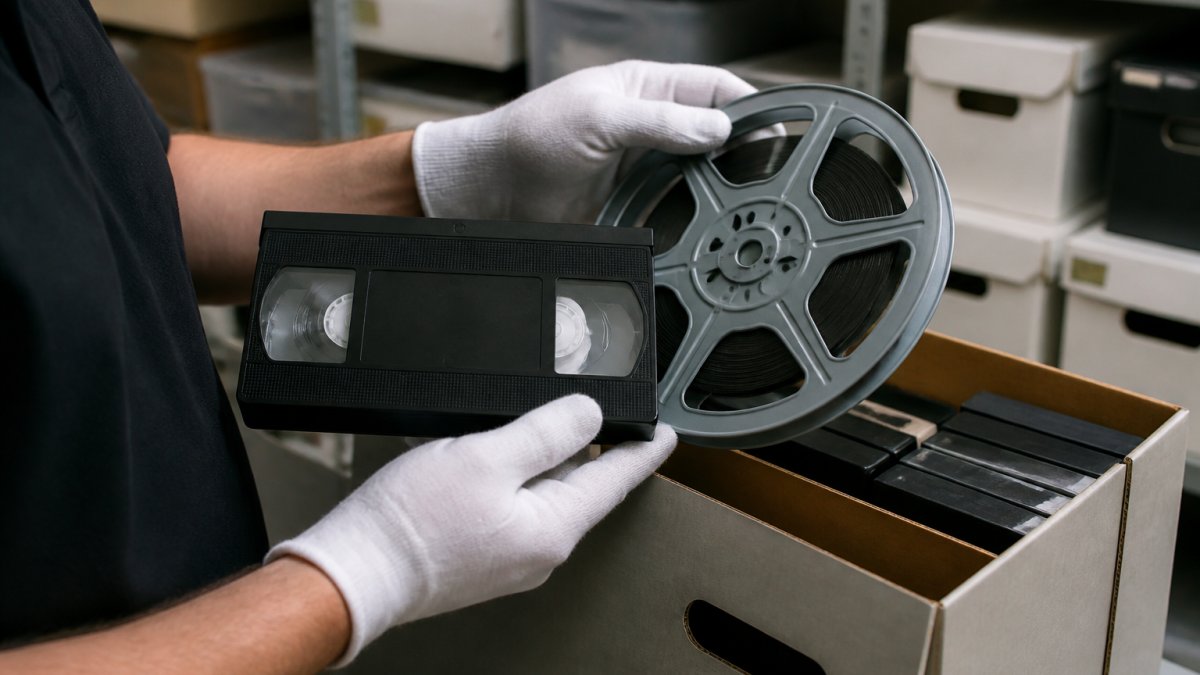
Ask about their handling process. Do they inspect tapes before digitising? Do they use protective equipment to avoid contaminating the media?
Privacy is equally important. Ask: Is media stored securely? Who has access? Are files encrypted? How long are originals kept? What’s the data deletion policy? A trustworthy service has clear answers.
DIY Digitisation Versus Professional Transfer Services
You can buy a VHS-to-digital converter online for under $100. For film, you can rent or buy a film scanner. Why pay for professional service when you can do it yourself?
The honest answer: DIY works if you have one or two tapes and you’re willing to accept lower quality and spend hours learning the process. For a collection of 20+ tapes, or if you have valuable footage, professional service is worth it.
Here’s what DIY costs you:
- Time: 1-2 hours per tape for learning, setup, and actual conversion
- Equipment: $100-500 depending on quality
- Mistakes: Improper playback can damage tapes further
- Quality: Consumer-grade converters produce noticeably lower quality than professional equipment
- Frustration: Dealing with tape jams, audio sync issues, and format compatibility problems
Professional services cost more upfront but save time, prevent damage, and deliver better quality. For family memories, that’s usually the right trade-off.
Conclusion: Finding the Right Service for Your Family Memories
Choosing among digitising memories alternatives comes down to what you prioritise: speed, cost, quality, or a combination. There’s no single best service for everyone, it depends on your collection size, budget, and timeline.
The right service handles your originals carefully, explains pricing upfront, delivers quality that makes your memories worth preserving, and respects the privacy of your family moments. With over 20 years of experience, professional-grade equipment, same-day turnaround in most cases, and transparent pricing, we’re built to handle collections of any size. Get a quote today and see how we can preserve your family memories for generations to come.
Your family videos are irreplaceable. They deserve more than a budget converter or a service that treats them like just another order. Showbiz Video Productions brings professional-grade equipment, careful handling, and genuine expertise to every tape, reel, and cassette. Preserve your memories the right way, get a quote from Showbiz Video Productions and start protecting your family’s story today.
Frequently Asked Questions
What makes one digitising memories service better than another?
The best digitising memories service combines professional-grade equipment, transparent pricing, fast turnaround, and proper handling of irreplaceable originals. Compare services on their experience with multiple formats (VHS, film reels, cassettes), whether they offer same-day or quick turnaround, how they protect your originals during transfer, and what digital formats they deliver. Services with over 20 years’ experience and professional-grade equipment typically produce higher-quality digital files and handle your media with greater care than newer or budget-focused operators.
Can VHS to digital conversion handle severely degraded or mouldy tapes?
Professional VHS to digital conversion services can often read tapes in poor condition, but success depends on the extent of damage. Mould, tape warping, or severe oxide shedding may prevent playback on standard equipment. Before committing, ask the service about their media condition assessment, many offer free evaluation. Showbiz Video Productions, for example, uses professional-grade equipment designed to handle aged and compromised media. Avoid sending tapes without checking their condition first, as some damage cannot be reversed.
What digital file formats should I choose for long-term video backup?
For digital file formats for video backups, choose widely supported formats like MP4 or MOV, which work on most devices and software. Avoid proprietary formats that may become obsolete. Ask your digitising service what formats they offer and whether they provide options for different uses, compressed files for sharing, or higher-quality masters for archiving. Store backups on multiple devices (external hard drive, cloud storage, USB) to protect against data loss. Professional services should clearly explain which formats they deliver and why.
How do I know a digitising service won’t lose or damage my tapes?
Choose a service with clear handling protocols and a strong track record. Ask about their process: Do they log each item? How do they protect originals during transfer? What insurance do they carry? Services with long operating history, professional facilities, and customer testimonials (like Showbiz Video Productions, rated 5 stars) demonstrate reliability. Request a quote that includes confirmation of safe return of originals. For high-value collections, ask whether they can photograph items before and after, providing proof of condition.