
Table of Contents
- What Makes a Media Transfer Service Reliable
- Cost to Convert Old Home Videos: What You’ll Actually Pay
- Professional Video Digitisation vs DIY: Which Approach Protects Your Memories
- Media Transfer Service Turnaround Times: Speed Without Compromise
- Supported Media Formats and Quality Standards
- How to Choose the Right Service for Your Collection
- Post-Transfer File Management and Long-Term Preservation
- Frequently Asked Questions
Last Updated: September 23, 2026
What Makes a Media Transfer Service Reliable
Reliability in media transfer services comes down to three factors: the quality of equipment, the expertise of the technician, and transparent handling of your irreplaceable originals. Professional media transfer services combine these elements to protect your memories. A service that cuts corners on any of these will compromise your memories.
The best indicator isn’t marketing claims, it’s whether the service uses professional-grade equipment, handles fragile media with documented care protocols, and stands behind their work with clear turnaround commitments. At Showbiz Video Productions, we’ve built our reputation over 20 years. Speed without quality is just fast damage.
Look for services that explain their process upfront. What happens to your tapes before digitisation? Are they cleaned? Inspected for damage? A reliable service will tell you if your media is degraded before they start, not surprise you with poor results afterward. They should also offer you choices about file formats and delivery methods, because your needs might differ from someone else’s.
The companies that survive in this space aren’t the cheapest. They’re the ones that treat each tape like it contains someone’s wedding day, because it probably does.
A reliable media transfer service combines professional equipment, transparent processes, and genuine care for your originals. Ask about their cleaning protocols, damage assessment, and what happens if media is unreadable.
Cost to Convert Old Home Videos: What You’ll Actually Pay
The cost of converting old home videos depends on three variables: how many items you have, what condition they’re in, and whether you want basic digitisation or advanced restoration.
Most services charge per item rather than by length, which means a 30-minute VHS tape costs the same as a 120-minute one. This is where pricing can surprise you if you’re not careful. A collection of 20 tapes adds up quickly if you’re comparing per-tape rates across services.
Pricing models vary significantly. Some services offer flat rates for standard formats, while others charge differently based on media type, film reels cost more than VHS because the scanning equipment is more specialised. A few services include basic cleaning and inspection in their base price; others charge extra for anything beyond a straight transfer.
The real decision point is whether you need restoration work. Basic digitisation captures what’s on the tape. Restoration involves colour correction, noise reduction, and sometimes frame-by-frame repair for damaged sections. This adds cost but can recover memories that would otherwise be lost to tape degradation.
At Showbiz Video Productions, we handle everything from bulk orders to single items with the same care. For current pricing, visit our website to get a quote tailored to your collection size and format mix.
Watch for hidden costs: some services charge extra for delivery, file format conversion, or storage of your originals after transfer. Ask about the complete cost upfront, including what happens to your tapes after the job is done.
Professional Video Digitisation vs DIY: Which Approach Protects Your Memories
DIY digitisation sounds appealing until you realise what’s actually involved. You need playback equipment for every format you own, VCRs for VHS, film projectors for Super 8, camcorder decks for Mini-DV. Most people don’t have these anymore, and buying used equipment is risky. A degraded playback head can damage your tape permanently.
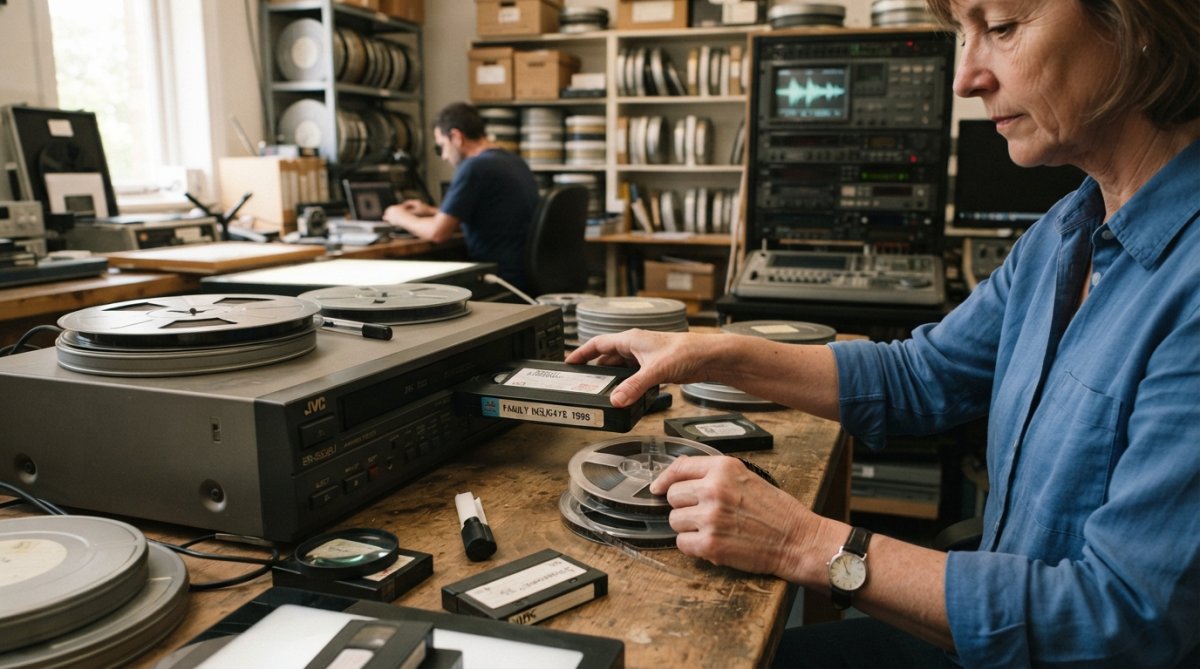
The capture side is equally complex. Connecting old equipment to modern computers requires adapters that often introduce signal loss. The software to capture video properly, with lossless compression and correct colour space handling, isn’t consumer-grade. Most people end up with compressed, degraded files that lose detail compared to what a professional service captures.
Professional services have invested in time-base correctors and frame-by-frame scanning equipment. These tools stabilise the video signal from aging tapes and recover detail that DIY setups simply can’t access. They also have the expertise to diagnose problems before they ruin your media, a warped tape or sticky tape syndrome can be identified and handled carefully, whereas a home setup might just jam and snap it.
The real risk with DIY isn’t just quality. It’s permanence. If your tape degrades during a failed DIY transfer, you’ve lost the original and have nothing to show for it. A professional service assumes that risk, not you.
For collections with sentimental value, the cost difference between DIY and professional service is insurance money, not an expense.
Media Transfer Service Turnaround Times: Speed Without Compromise
Turnaround time varies wildly depending on the service’s capacity and your collection size. Some services promise same-day or next-day turnaround for small orders; others require 2-3 weeks because they batch jobs for efficiency.
Same-day service sounds ideal until you ask what it actually means. Does it include restoration work, or just basic transfer? Is it available for all formats, or only VHS? Some services offer fast turnaround on small orders but slow down significantly for large collections because they’re prioritising speed over quality on individual items.
The most reliable services are transparent about their timeline. They’ll tell you upfront: “Your 10 tapes will be ready in 5 business days,” not “3-7 days depending on our workload.” This clarity matters because you’re handing over irreplaceable media.
Batch processing, where a service waits to accumulate multiple orders before starting work, can actually be better for quality. It allows technicians to work systematically without rushing. But it means your job might take longer if you’re the first person to submit.
At Showbiz Video Productions, we offer same-day service in most cases because we’ve structured our workflow to handle volume without sacrificing care.
Ask the service what “turnaround time” includes. Does it start when they receive your media or when they begin processing? Does it include time for you to collect your files, or just the transfer work itself? The difference between 3 days and 10 days often comes down to how they measure it.
Supported Media Formats and Quality Standards
A reliable media transfer service handles more than just VHS. Your collection probably includes multiple formats, VHS, VHS-C, Hi-8, Video 8, Mini-DV, Super 8, or even Betamax. Each requires different playback equipment and different handling approaches.
VHS and VHS-C are the most common formats people still have. VHS-C (camcorder format) requires specialised decks that are increasingly hard to find. Mini-DV and Digital 8 are more recent but equally at risk of degradation. Super 8 and 16mm film require optical scanning rather than magnetic tape playback, a completely different process.
Quality standards matter more than format support. A service that handles 10 formats but uses consumer-grade capture equipment will produce lower-quality results than a service that specialises in 3 formats with professional-grade scanning. Ask about their resolution output, are they capturing at 720p, 1080p, or higher? What colour space are they using? Are they de-interlacing properly to avoid ghosting artefacts?
Archival quality means lossless or near-lossless capture. This produces larger files but preserves every detail from the original.
How to Choose the Right Service for Your Collection
Start by listing what you actually have. Count the tapes by format: how many VHS, how many film reels, how many camcorder tapes? This inventory determines which services are even capable of handling your collection. A service that only does VHS won’t help if you have film reels.
| Selection Criteria | What to Ask | Why It Matters |
|---|---|---|
| Equipment Quality | What’s your capture resolution? Do you use time-base correction? | Higher quality equipment recovers more detail from degraded media |
| Format Support | What formats can you handle? | Your collection might include formats not all services support |
| Process Transparency | Do you inspect media before transfer? What’s your damage protocol? | Reveals whether they prioritise preservation or speed |
| Turnaround Time | What’s your actual timeline for my collection size? | Helps you plan and avoid services that can’t meet your deadline |
| File Delivery Options | What formats and delivery methods do you offer? | Determines whether you get files you can actually use long-term |
Post-Transfer File Management and Long-Term Preservation
Getting your files back is only half the job. You now own digital media that needs to be stored safely, backed up properly, and organised so you can actually find things years from now.
Before you delete your original tapes after digitisation, verify your digital files actually work. Play them on different devices. Check that the files you received match what you expected. Only after confirming successful transfer should you consider what to do with the originals.
Frequently Asked Questions
What formats can reliable media transfer services handle?
Professional media transfer services digitise VHS, VHS-C, Mini-DV, 8mm, Super 8, Hi-8, Video 8, Digital 8, Betamax, and audio cassettes. Reputable providers have archival-quality equipment to handle degraded magnetic tape and fragile film reels. Before committing, confirm the service supports your specific format, not all providers handle every tape type equally well.
How much does it cost to convert old home videos to digital?
Costs vary significantly based on quantity, tape condition, and desired output quality. Basic digitisation starts affordably, while services offering colour correction, restoration, and professional-grade equipment may cost more per item. Check each service’s pricing page for transparent, per-item rates.
Is it safer to digitise home videos professionally or DIY?
Professional digitisation is safer for irreplaceable memories. DIY equipment risks damaging original tapes through improper handling, degraded playback heads, or incorrect settings. Professionals use time base correctors and lossless capture technology to preserve content without harming originals. For tapes showing physical deterioration or magnetic tape degradation, professional handling with pre-transfer cleaning is essential to recover what remains.
How quickly can I get my videos back after transfer?
Turnaround times range from same-day service to several weeks, depending on volume and service type. Local drop-off services typically offer faster turnaround than mail-in options. Ask about realistic timelines for your collection size, some providers promise speed only for small jobs. Confirm whether quoted times include file delivery, cloud upload, or physical media creation.
What should I look for when choosing a media transfer service?
Prioritise professional-grade equipment, transparent pricing, and proven experience with your specific formats. Check for archival-quality standards, secure handling protocols, and clear turnaround commitments. Read customer reviews about how originals are returned. Ask about pre-transfer cleaning, colour correction capabilities, and output format options. Verify the service handles degraded media safely and offers the delivery method you need, USB, cloud storage, or physical media.