
Table of Contents
- Tapes to Digital vs Local Conversion Services: The Core Trade-Off
- What Mail-In Services Like Tapes to Digital Offer
- What Local Conversion Services Bring to the Table
- Side-by-Side Comparison: Quality, Speed, Cost and Safety
- VHS to Digital Conversion Cost: What Actually Drives the Price
- DIY vs Professional Tape Conversion: When Each Option Makes Sense
- Turnaround Time for Media Conversion: Same-Day vs Weeks
- Troubleshooting and Risk: What Happens When Tapes Are Damaged
- Where Tapes to Digital Wins and Where Local Services Win
- Frequently Asked Questions
Last Updated: September 10, 2026
Tapes to Digital vs Local Conversion Services: The Core Trade-Off
When your tapes have sat untouched for years, the tapestodigital vs local conversion services decision comes down to one tension: convenience versus control. Mail-in services ship you a kit, you post your tapes away, and you wait. Local services, including Showbiz Video Productions, let you hand your irreplaceable home movies to a person across a counter and often get them back the same day. That difference matters, because a tape that has already started to degrade does not travel well.
This guide breaks down the cost, speed, quality and risk of each route.
What Mail-In Services Like Tapes to Digital Offer
Mail-in conversion services send you a shipping kit, process your tapes at a central facility, and return the originals with digital copies. The appeal is a structured, hands-off process: pack a box, book a courier, track progress online.
The trade-offs are real. Your tapes travel through a postal network, sit in a processing queue, and are handled by staff you never meet. Turnaround is measured in weeks, not days, and any playback problem means a phone call rather than a conversation.
Australia Post guidance on sending valuable items notes that items can be delayed or damaged in transit, which is worth weighing when the contents are irreplaceable.
What Local Conversion Services Bring to the Table
Local conversion services digitise your media on-site, using professional-grade decks and capture equipment you can inspect before you commit. You keep custody of your tapes until they are processed, and usually get them back the same visit.
That proximity changes the risk profile. If a tape is mouldy, snapped or suffering from sticky-shed syndrome, a technician can flag it immediately instead of discovering it three weeks into a mail-in queue. One business can also handle mixed collections: VHS, Hi8 camcorder tapes, 8mm film reels, audio cassettes and vinyl in a single job.
Side-by-Side Comparison: Quality, Speed, Cost and Safety
| Factor | Mail-In Service | Local Conversion Service |
|---|---|---|
| Custody of tapes | Shipped away for weeks | Stay local, often same day |
| Turnaround | Typically weeks | Same-day to a few days |
| Equipment visibility | Not inspectable | Can be viewed on site |
| Format range | Usually broad | Broad, including film and vinyl |
| Damaged-tape handling | Remote assessment | Immediate, in-person triage |
| Best for | Large collections, flexible timelines | Urgent or fragile media |
Neither option is universally better in the tapestodigital vs local conversion services debate. The right pick depends on how fragile your tapes are and how quickly you need them back.
VHS to Digital Conversion Cost: What Actually Drives the Price
VHS to digital conversion cost is driven by four things: the number of tapes, their condition, the output format you want, and how fast you need the job done. A tape in good condition costs less than one needing cleaning, splicing or manual restoration, but the invoice is built from pricing mechanisms most comparison pages never spell out.
Per-tape versus per-hour billing. Some providers charge a flat rate per cassette regardless of runtime; others bill by the hour of footage captured. A flat per-tape rate favours long recordings, while per-hour billing favours short tapes. Always ask which model applies before comparing headline rates, because a “$6 per item” figure and a “$25 per hour” figure are not the same quote.
Minimum charges and call-out fees. A single tape is rarely economic to set up a deck for, so many providers apply a minimum order, commonly five to ten items. Local on-site services may also charge a call-out or inspection fee to assess fragile media before committing.
Format surcharges. VHS is the cheapest format to process because working decks and capture chains are still relatively common. Expect a higher per-item rate for:
- Betamax, decks are scarce and often need servicing before a job.
- Hi8 and Video8, camcorder tapes frequently suffer from dropout and need head-cleaning mid-capture.
- 8mm and Super 8 film, these require telecine transfer, not tape capture, and are priced per reel rather than per hour.
- Audio cassettes and vinyl, usually priced separately again, often at a lower per-item rate than video.
Restoration add-ons. Cleaning a mouldy tape, splicing a snapped leader, or manual colour correction are almost always quoted as extras. Ask for these to be itemised separately so you can see what a “clean” tape would have cost versus the one you actually have.
Output and delivery. This is where quotes diverge most. A compressed MP4 on a USB stick is cheapest. Archival-quality files (high-bitrate MP4 or lossless) take longer to render and occupy more storage, so they cost more. Delivery on an external hard drive, or cloud upload, adds a hardware or bandwidth cost.
Bulk pricing matters for larger collections. If you have 30 tapes, ask whether the per-item rate drops at volume, and at what threshold, a common pattern steps down at 10, 25 and 50 items.
Showbiz Video Productions publishes its pricing on its website with rates starting from $6 per item, so you can see the numbers before you commit rather than chasing a quote.
Always ask whether the price includes the return of your original tapes. Some budget services treat the physical media as disposable, which is a problem if you later want a second transfer at a higher bitrate. Ask too whether the quoted rate covers the full runtime of each tape or only the first hour, long-play recordings are a frequent source of invoice surprises.
A note on DIY cost. It is tempting to compare a professional quote against a capture card and a second-hand VCR. Factor in the working deck (increasingly hard to source), the capture hardware, external storage, and the hours learning deinterlacing and codec settings. For a handful of casual tapes DIY can be cheaper; for anything fragile, long or irreplaceable, the professional quote is usually the lower total cost once your time is priced in.
DIY vs Professional Tape Conversion: When Each Option Makes Sense
DIY vs professional tape conversion is a question of equipment, time and risk tolerance. Doing it yourself means buying a capture card, sourcing a working VCR, learning deinterlacing and codec settings, and accepting whatever quality your consumer deck produces.
That is fine for a handful of casual tapes in good condition. It stops making sense when the tapes are the only copies of irreplaceable memories, or the source is a format you cannot easily play, such as Betamax, Hi8 or 8mm film.
Professional conversion handles the technical layer: correct frame rate matching for NTSC vs PAL sources, proper deinterlacing, and archival-quality output rather than a compressed file that looks soft on a modern television.
Turnaround Time for Media Conversion: Same-Day vs Weeks
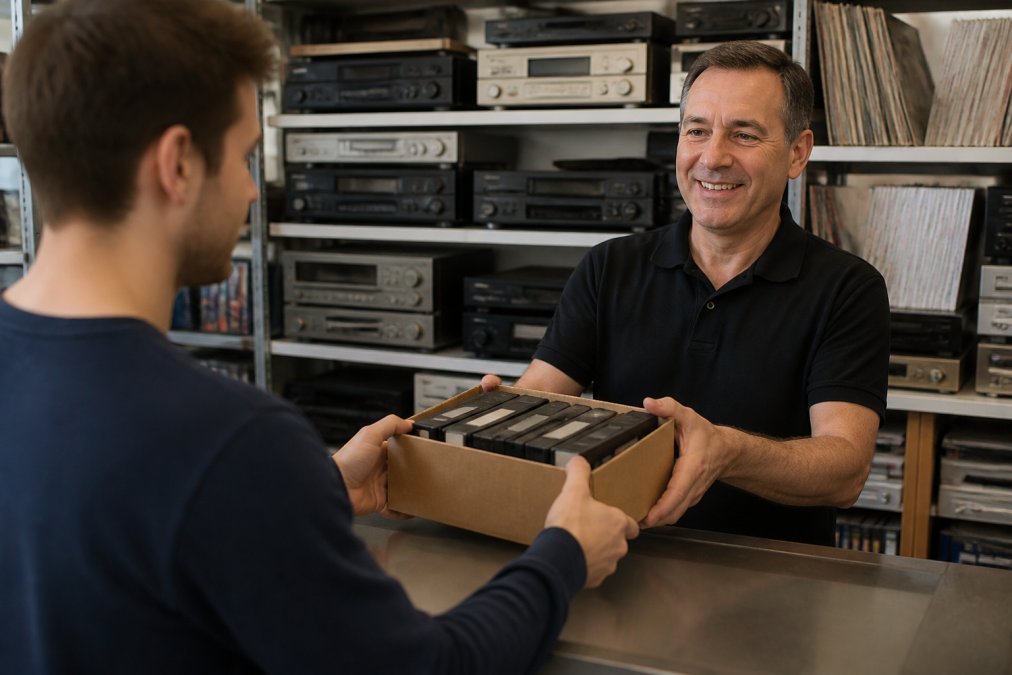
Turnaround time for media conversion ranges from same-day service at a local provider to several weeks with a mail-in service, the difference between a job you collect on your lunch break and one that disappears into a postal queue.
What actually determines turnaround. Four variables drive the timeline:
- Queue depth. A local shop with a small backlog can start your job the same day. A centralised mail-in facility processes jobs in the order they arrive, so your tapes sit in a queue behind everyone else’s.
- Tape condition. A clean tape captures in real time, a 180-minute VHS takes roughly three hours to play through and capture (Library of Congress catalog data). A mouldy or snapped tape adds cleaning, splicing and test-playback time before capture even begins.
- Format. VHS and Hi8 capture in real time. Film reels require telecine transfer, which is slower per minute of footage and often batched. Audio and vinyl are usually faster per item.
- Output specification. A compressed MP4 can be delivered as soon as capture finishes. Archival-quality files need additional rendering and quality-checking time.
Realistic timelines. Same-day service is achievable for a single tape in good condition at a local provider with spare capacity. A mixed collection of 20 to 30 tapes typically takes a few days to a week locally. Film reels and large mixed jobs are commonly quoted in weeks regardless of where you send them, because the bottleneck is the transfer equipment, not the postage.
How to plan around it. If you have a deadline, a birthday, an anniversary, a funeral, tell the provider up front and ask what is genuinely achievable. Confirm the timeline before you hand anything over, and ask what happens if a tape needs repair partway through: does the clock stop, and does the quote change?
The part most guides skip: what happens after the files arrive. Turnaround is only half the story. The digital files you get back are not automatically safe, a single USB stick or external drive is a single point of failure. A sensible preservation strategy uses the 3-2-1 rule: at least three copies, on two different types of media, with one copy stored off-site (National Institute of Standards and Technology – Cybersecurity Framework).
In practice that means:
- A working copy on your computer or a fast external SSD for everyday viewing and editing.
- A local backup on a separate external hard drive kept in a different room from the working copy.
- An off-site copy in cloud storage or a second physical location, so a fire, flood or theft cannot take out every copy at once.
Choose archival formats for the master. Keep the highest-quality file your provider supplies as the master copy and generate smaller MP4s for sharing. Compressed files are fine for sending to family; they are a poor long-term master because repeated re-encoding degrades quality.
Check the files before you archive them. Play each file end to end within the first week. Confirm the audio is in sync, the runtime matches the original tape, and nothing has dropped out. It is far easier to raise a problem immediately than months later.
Turnaround is a logistics question you can plan for; preservation is a decision you have to make deliberately. Whichever service you choose, ask what file format the master will be delivered in, get it onto at least two separate drives, and keep one copy off-site. The conversion is the easy part, keeping the files readable for the next 30 years is the part that actually protects your family memories.
Troubleshooting and Risk: What Happens When Tapes Are Damaged
Damaged tapes are the single biggest reason local service wins on risk. Mould, snapped leaders and binder breakdown all require a technician to assess the tape physically before playback. Playing a mouldy tape through a dirty deck can contaminate the machine and destroy the footage.
A local provider can clean the tape, splice a broken leader, and test playback on professional equipment before committing to a full capture. A mail-in service does the same work remotely, and any problem becomes a phone call and a delay rather than a five-minute conversation.
Never attempt to play a tape that smells musty or shows white powder on the reels. Running it through a household VCR can spread mould to the heads and ruin both the tape and the machine.
Where Tapes to Digital Wins and Where Local Services Win
Mail-in services win on convenience for large, strong collections where you are happy to wait and the tapes are in reasonable condition, a single kit, a single courier booking, and a predictable process with no travel.
Local services win when the media is fragile, urgent or mixed. If you have a box of 1990s VHS tapes plus film reels and vinyl, one local provider can process the lot without splitting the job across multiple mail-in kits. That is where Showbiz Video Productions fits: over 20 years of experience, same-day turnaround in most cases, and VHS, film reels, cassettes and vinyl under one roof.
For a collection you cannot replace, handing it to a person you can actually speak to is worth more than a marginally lower per-item rate.
Your tapes will not improve with age. Magnetic media degrades, mould spreads, and playback equipment gets harder to find each year. If your collection includes fragile or mixed formats, or you simply want it back fast, Showbiz Video Productions offers professional-grade conversion with same-day turnaround in most cases, transparent pricing from $6, and over 20 years of experience handling irreplaceable family media. Get a quote from Showbiz Video Productions and preserve your memories in a format you can actually watch.
Frequently Asked Questions
How do I choose between a national digitisation service and a local shop?
Start by checking how each handles your specific formats. National mail-in services like Tapes to Digital often provide a kit and standardised pricing, but they may not handle rare formats or offer same-day turnaround. Local services can inspect tapes on-site, repair mould or broken cassettes, and let you collect finished files in person. If you have a mix of VHS, film reels and audio cassettes, or you’re worried about damage, a local option gives you more control and faster answers.
Is it safer to use a local conversion service or a mail-in provider?
Both carry some risk, but local services remove the shipping step entirely. Mail-in providers pack tapes in kits, which adds transit time and handling. Local drop-off means your tapes go from your hands to the technician’s bench without courier involvement. For irreplaceable family recordings, that reduced handling matters. Ask any provider about their process for cleaning and repairing tapes before playback, and whether they test-play a sample first.
What affects VHS to digital conversion cost the most?
The biggest cost drivers are the number of tapes, the condition of each tape, and the output format you need. Tapes with mould, broken reels or poor tracking require manual repair, which adds labour. Standard VHS to MP4 is usually the base rate. Adding restoration, higher resolution upscaling or cloud delivery increases the total. Local services may charge per tape or per hour; mail-in kits often bundle a set number of tapes. Always ask for a written quote before committing.
How long does it take to convert old video tapes to digital files?
Turnaround time for media conversion varies widely. Some local services offer same-day or next-day delivery for small batches, while mail-in providers typically take one to three weeks including shipping. Larger collections or tapes needing repair can take longer. If you need files quickly for a birthday, anniversary or memorial, ask specifically about same-day availability and whether it applies to your formats. Confirm the delivery method too: USB, external hard drive or cloud download.
What should I look for when comparing video tape conversion quality?
Ask about the capture equipment, the file format and the resolution. Professional services use broadcast-grade tape decks and capture cards that preserve the original frame rate and bitrate. They also handle deinterlacing properly so playback isn’t jerky. Check whether they offer restoration for colour fade, audio hiss or dropouts. For long-term storage, request archival quality files rather than heavily compressed versions. A good provider will explain their workflow and let you see a sample before converting everything.