Table of Contents
- Quick Comparison: 5 Tapes to CD Converter Options
- How We Evaluated These Converters
- 1. Showbiz Video Productions: Best Overall Tapes to CD Converter Service
- 2. TEAC AD-850: Best Standalone Cassette to Digital Converter
- 3. Audacity: Best Free DIY Option
- 4. ClearClick Cassette2USB: Best Budget Hardware Converter
- 5. Forever Studios Audio Transfer: Best for Fragile Tapes
- Professional Cassette Transfer Cost: What to Expect
- Frequently Asked Questions
Last Updated: September 22, 2026
Quick Comparison: 5 Tapes to CD Converter Options
Finding a reliable tapes to CD converter comes down to one question: do you want to hand your memories to a professional, or spend weekends wrestling with cables? At Showbiz Video Productions, we’ve spent over 20 years converting cassettes, VHS tapes, and film reels. This review compares five real options across price, quality, and effort.
Here’s how they stack up:
| Option | Type | Best For | Effort Required |
|---|---|---|---|
| Showbiz Video Productions | Professional service | Most people with irreplaceable tapes | None |
| TEAC AD-850 | Standalone hardware | No-computer households | Moderate |
| Audacity | Free software | Tinkerers with a tape deck | High |
| ClearClick Cassette2USB | Budget hardware | Casual home users | Moderate |
| Forever Studios Audio Transfer | Mail-in service | Fragile or high-value tapes | Low |
The short version: professional conversion wins for anything sentimental. Hardware and software suit people who enjoy the process and own working playback gear. Most households don’t.
How We Evaluated These Converters
We scored each option on four criteria: output quality, ease of use, cost, and how well it handles aging or damaged media.
Output quality matters most. A cassette to digital converter is only as good as its weakest link, whether that’s a worn tape head or aggressive MP3 compression. We prioritised options that preserve audio fidelity at archival quality rather than squeezing files down to the smallest possible size.
Ease of use separates a pleasant afternoon from a frustrating month. Hardware and software demand a working tape deck, correct cable connections, and patience with playback speed and level settings. Services remove that burden entirely.
Cost is rarely just the sticker price. DIY routes hide expenses in equipment, cables, audio interfaces, and your own time. We factored all of it in.
1. Showbiz Video Productions: Best Overall Tapes to CD Converter Service
Showbiz Video Productions is a professional media conversion service that turns cassettes, VHS tapes, film reels, and vinyl into high-quality digital files. For anyone with irreplaceable family recordings, it is a highly recommended option.
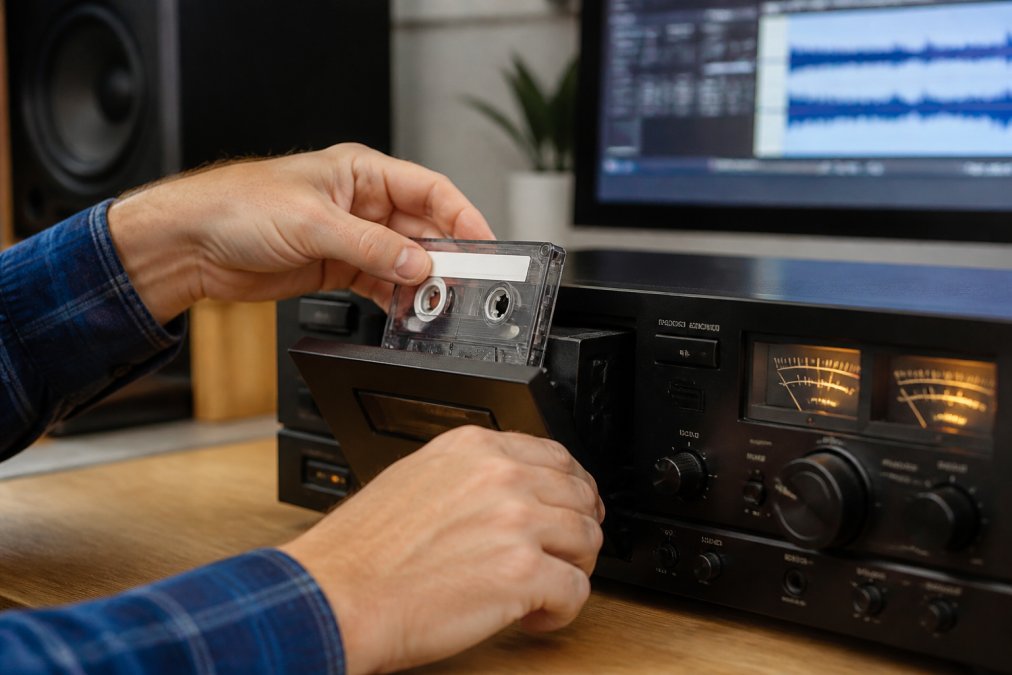
The appeal is simple: you hand over the box, and you get back clean digital files plus your originals. No cables, no software, no risk of wrecking a tape you cannot replace. Every job runs on professional-grade equipment, and most orders are turned around the same day.
What actually happens to your tape
Inspection and preparation. Every tape is checked before it touches a deck. We look for mould, water damage, a snapped or stretched ribbon, and the tell-tale squeal of sticky-shed syndrome, where the binder layer on the tape breaks down and gums up the playback head. A tape in that state may need cleaning, sometimes re-housing into a fresh shell, and a slow, monitored pass on a deck that can be stopped instantly if the ribbon starts to bind.
Playback and capture. Transfer runs on a calibrated deck with correct azimuth alignment, so the playback head reads the track at the angle it was recorded. Audio is captured to uncompressed files at archival resolution, not compressed on the way in.
- Hiss from ageing tape stock or a noisy playback chain, reduced with broadband noise reduction rather than a blunt low-pass filter that also kills the top end.
- Crackle and clicks from surface contamination or tape wear, repaired by identifying and interpolating individual damaged samples.
- Wow and flutter, the slow pitch wobble caused by uneven tape transport, corrected with time and pitch adjustment.
- Level and EQ balancing, so quiet passages are audible and loud passages do not clip.
Pricing and turnaround
Pricing starts at just $6, and there is no job too big or too small. A handful of tapes gets the same care as a full archive. If you have been quoted elsewhere and wondered whether the gap is worth it, it’s worth noting that Showbiz Video Productions uses professional-grade equipment. Most orders are turned around the same day.
Pros and Cons
Pros:
- Over 20 years of experience handling legacy formats
- Same-day service in most cases
- Transparent pricing from $6
- Professional-grade equipment for every job
- Audio restoration included, not sold as an extra
- Handles mixed collections in one place
Cons:
- You need to drop off or post your media rather than doing it at home
Who It Is For
Anyone who values the recording more than the process. If your tapes hold weddings, childhoods, or voices you cannot get back, professional handling removes the risk. It also suits people who own no working cassette deck, which is most of us now, and anyone whose tapes are already showing signs of mould, squealing, or physical damage.
The real cost of DIY is not the equipment, it is the risk. A snapped tape or a misaligned deck can erase audio permanently. Professional conversion can help prevent such issues, and the restoration step can enhance the listenability of a file.
2. TEAC AD-850: Best Standalone Cassette to Digital Converter
The TEAC AD-850 is a combination CD player and cassette deck that records straight from cassette to a USB flash drive as MP3 files. It’s the simplest hardware route for anyone who doesn’t want a computer involved.
Pros:
- No computer or software needed
- Doubles as a playback deck
- Straightforward operation
Cons:
- Limited to 128kbps MP3 output
- No audio restoration or noise reduction
3. Audacity: Best Free DIY Option
Audacity is free, open-source audio software for recording and editing sound from an external tape player. It costs nothing and gives you more control than any hardware converter on this list.
4. ClearClick Cassette2USB: Best Budget Hardware Converter
The ClearClick Cassette2USB is a portable converter that plugs into a computer over USB to transfer cassette audio into digital files. It ships with capture software and runs on battery or USB power.
Cheap USB converters often use basic playback heads that struggle with worn or stretched tapes. If a tape plays with wobble or dropouts, the fault is usually the deck, not the tape.
5. Forever Studios Audio Transfer: Best for Fragile Tapes
Forever Studios Audio Transfer is a mail-in service that digitises cassettes and reel-to-reel tapes into digital files or CDs. Technicians make manual EQ and compression adjustments, separate individual tracks, and return your original media with the order.
Professional Cassette Transfer Cost: What to Expect
Professional cassette transfer cost depends on quantity, tape condition, output format, and turnaround. There is no single national rate. What you can do is understand the levers, so you can compare quotes like for like.
The four cost drivers
Volume. Per-tape rates may vary based on the size of your order. If you have a shelf of tapes, it’s advisable to ask for a quote that considers the volume.
A realistic way to budget
Rather than chase a single headline rate, build a rough estimate in three steps:
- Count your tapes and sort them into standard and fragile.
- Decide whether you need lossless files or MP3 is genuinely enough.
- Choose a turnaround you can actually live with.
The hidden cost of DIY
The sticker price of a USB converter or a second-hand deck is only part of the DIY bill. Add a working cassette player if you do not own one, a USB audio interface for a clean signal, cables, capture software, and the hours spent babysitting playback, splitting tracks, and re-recording anything that came out with hum or dropouts. If a tape snaps mid-transfer, the cost is not money, it is the recording.
Sort your tapes before getting a quote. Separate the must-saves from the maybes, and flag anything mouldy, water-damaged, or previously snapped. A clear list gets you an accurate price and stops you paying to digitise recordings nobody wants.
Frequently Asked Questions
Can I still buy a tapes to CD converter in Australia?
Yes, dedicated hardware like the TEAC AD-850 and ClearClick Cassette2USB are available through Australian retailers and online stores. However, many people find professional services simpler because they handle fragile tapes, audio restoration, and format choices for you. If you only have a few tapes, a service often works out cheaper than buying equipment you will use once.
Is it better to convert tapes to CD or digital files like MP3?
It depends on how you plan to listen. CDs work well for car stereos and older home systems, but digital files are more flexible for sharing, backing up, and playing on phones or computers. For long-term archiving, WAV files preserve the most audio detail, while MP3 is convenient but compressed. Many professional services deliver both formats so you are covered either way.
How do professional conversion services compare to home converters?
Home converters are affordable upfront but may be limited by the quality of your playback equipment and the condition of your tapes. Professional cassette transfer services, like Showbiz Video Productions, use professional-grade equipment, offer audio restoration, and handle fragile media with care. If your tapes are irreplaceable or have mould, stretching, or dropouts, a professional service can help reduce the risk of further damage and often produces a cleaner result.
What are the risks of using cheap tape-to-CD conversion hardware?
Budget converters may use basic tape mechanisms that could potentially snag or stretch fragile tape, and they might record at lower bitrates, which can affect audio fidelity. Some may also lack advanced noise reduction, potentially leaving hiss and hum in the final file. If a tape breaks during playback on such equipment, the recording could be lost. For sentimental or rare recordings, professional handling can offer greater peace of mind.
What is the best audio format for archiving old cassette tapes?
WAV is the best audio format for archiving because it stores uncompressed audio at full quality, making it ideal for long-term digital preservation. A common approach is to save a WAV master and then create MP3 copies for everyday listening. If you use a professional service, ask for WAV files at a high sample rate and bit depth so you have a clean master to work from in the future.