
Table of Contents
- Why Same-Day VHS Digitisation Matters
- VHS to Digital Conversion Quality Comparison: Professional vs DIY
- How the Digitisation Process Works
- Supported Tape Formats and Video Types
- Cost of Digitising VHS Tapes and Delivery Options
- VHS to USB Transfer Service: What to Expect
- Preservation and Restoration for Degraded Tapes
- Bulk Digitisation and Family Archive Strategy
- Frequently Asked Questions
Last Updated: October 1, 2026
Why Same-Day VHS Digitisation Matters
Your family’s most precious memories are stored on VHS tapes that are literally deteriorating, making same day vhs digitisation essential before they’re lost forever. Same-day VHS digitisation means you don’t have to wait weeks wondering if your memories will survive long enough to be rescued.
You’re not just converting tape to digital files, you’re preserving irreplaceable moments: your child’s first steps, a grandparent’s voice, family gatherings that exist nowhere else. The longer you wait, the greater the risk of permanent loss.
Same-day service moves your memories from fragile physical format to secure digital files within hours, the difference between saving a memory and losing it forever.
Professional-grade equipment now handles conversion quickly without sacrificing quality. You get high-quality digital files that play on modern devices, stored safely on USB, DVD, or cloud storage, no special playback equipment needed, no format obsolescence risk.
VHS to Digital Conversion Quality Comparison: Professional vs DIY
The choice between professional and DIY digitisation isn’t just about speed, it’s about what happens to your tapes during the process and what quality you get back.
Professional-Grade Equipment and Results
Professional digitisation uses calibrated equipment for tape cleaning, colour correction, and frame-rate stabilisation, adjustments DIY setups can’t perform.
Professional services prevent further damage through pre-transfer cleaning, which removes dust and debris before transfer. Equipment reads the tape at optimal speed with proper colour balance and contrast.
Professional digitisation captures resolution at the source. A VHS tape contains roughly 240 lines of vertical resolution. Professional equipment preserves that information during transfer.
DIY Options and Their Limitations
DIY digitisation typically involves connecting an old VCR to a computer via a capture card or using community facilities. The appeal is obvious: no cost and same-day results.
Without pre-cleaning, dust and debris transfer directly into your file. Audio sync issues and colour problems can’t be corrected.
DIY requires technical knowledge of codecs, frame rates, and file formats. Mistakes in settings can result in unplayable files, and you’re responsible for physical handling, one slip can cause damage that makes professional recovery impossible.
Community facilities are free but depend on booking availability and your technical skill.
For irreplaceable family memories, professional digitisation offers expertise and calibrated equipment.
How the Digitisation Process Works
Understanding what happens to your tape during digitisation explains why same day vhs digitisation doesn’t mean rushed or lower-quality work. It’s a straightforward process that modern equipment performs efficiently.
Tape Assessment and Cleaning
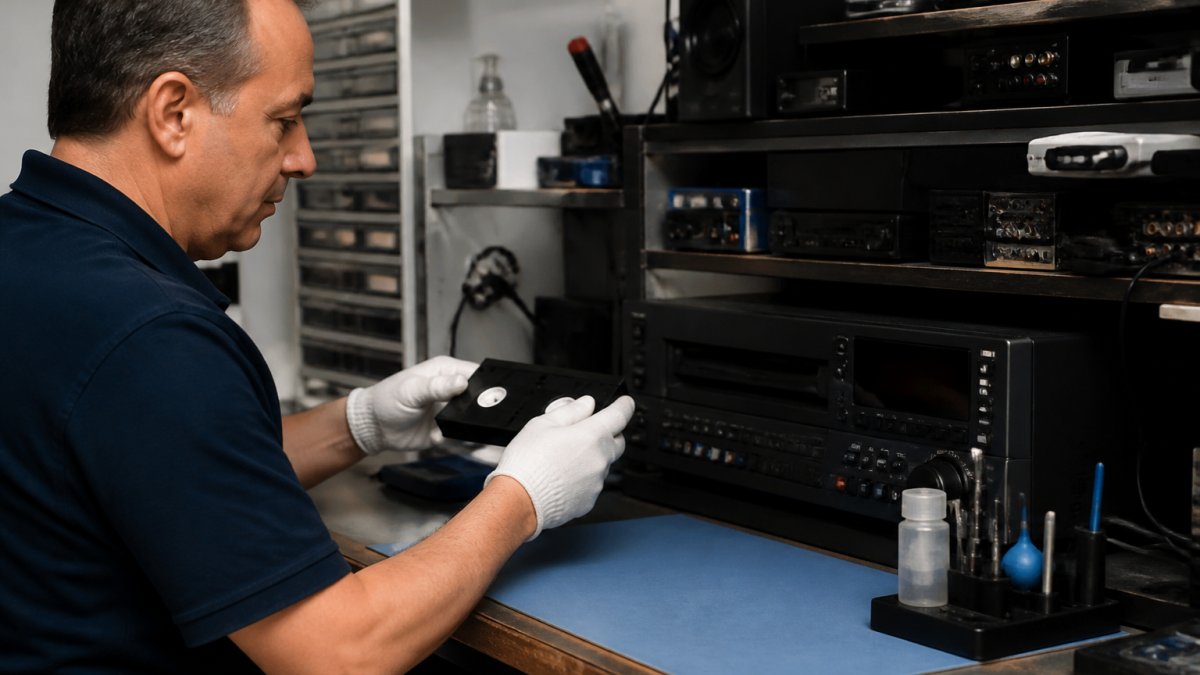
A technician examines your tape for visible damage, mould, brittleness, warping, or loose reels, to determine if special handling is needed.
Pre-transfer cleaning removes decades of dust and debris using specialised equipment that won’t damage the magnetic coating, preventing hundreds of particles from transferring into your digital file.
Transfer and Format Conversion
The clean tape feeds through a professional playback deck at precisely the correct speed. A real-time encoder captures video and audio streams simultaneously without compression loss.
The system monitors for dropout, colour shift, and audio sync drift.
Files are created in professional format and converted to your choice: MP4 for sharing, MOV for editing.
A 2-hour VHS tape transfers in real-time (2 hours), with format conversion taking 15-30 minutes.
Supported Tape Formats and Video Types
Your tape collection probably includes more than just standard VHS. Understanding what formats are supported matters because some require different equipment or handling.
Camcorder Tapes: VHS-C, Hi8, MiniDV, and Digital8
VHS-C tapes are smaller than standard VHS and require a mechanical adapter or compatible camcorder for playback.
Hi8 and Video8 tapes are more fragile and require careful handling during playback.
MiniDV tapes are digital from the source, so digitisation is direct format conversion rather than analog-to-digital transfer.
Digital8 is digital video on Hi8-sized tape, requiring specific playback equipment.
DIY typically only handles standard VHS.
Film Reels, Audio Cassettes, and Vinyl
8mm and 16mm film reels require a film scanner that projects each frame onto a sensor. This process is slower than tape digitisation.
Audio cassettes digitise similarly to VHS.
Vinyl records require a turntable connected to a high-quality audio interface.
Showbiz Video Productions supports VHS, VHS-C, Hi8, MiniDV, Digital8, 8mm film, audio cassettes, and vinyl.
Cost of Digitising VHS Tapes and Delivery Options
Pricing for digitisation varies based on format, quantity, turnaround time, and output options. Understanding the factors that affect cost helps you budget accurately.
Understanding Transparent Pricing
Showbiz Video Productions offers transparent pricing starting at $6 per item with no minimum orders or hidden fees. Same-day service is available for most jobs.
The real cost of digitisation isn’t the service fee, it’s the cost of NOT doing it. Every year your tapes sit in storage, the risk of permanent loss increases.
Digital Output Options: USB, DVD, and Cloud Storage
USB flash drives are the fastest delivery option. Files plug into any computer, TV, or modern device. USB is ideal for editing or immediate backup with no subscription required.
DVD plays in most DVD players and computers, ideal for sharing with family. A DVD stores up to 4.7GB of video (1-2 hours).
Cloud storage allows family scattered across locations to view files without physical media.
VHS to USB Transfer Service: What to Expect
USB transfer has become the default output for digitisation because it offers the best combination of quality, accessibility, and flexibility.
File Format Compatibility and Playback
Files arrive in standard format (typically MP4 or MOV) that plays on virtually any device, computers, smartphones, tablets, smart TVs, and media players, without special software.
Full-resolution files contain all captured detail and can be edited, shared on social media, or watched on your TV.
A 2-hour VHS tape typically converts to 4-8GB of video.
Turnaround Times and Same-Day Availability
Same-day digitisation is available for most jobs.
Preservation and Restoration for Degraded Tapes
Not every tape is in perfect condition. Many have spent decades in attics, basements, or garages where temperature and humidity fluctuate. Understanding what degradation looks like and what can be recovered matters.
Recognising Tape Degradation Signs
Colour shift (reddish or greenish tint) occurs when the magnetic coating oxidises. It’s cosmetic but visible.
Horizontal lines indicate dropout, where the magnetic coating has flaked off. Dropout is more serious than colour shift but still recoverable if not extensive.
Audio dropout (sound cutting out or becoming muffled) is common in older tapes.
Warping or brittleness means the tape is physically failing. Forcing a brittle tape through a standard VCR can cause it to snap or shed coating.
Mould growth (visible discolouration or musty smell) indicates damp storage.
Never attempt to play a mouldy, warped, or visibly damaged tape on a standard VCR. The playback mechanism can cause irreversible damage. Professional equipment includes safeguards for handling fragile media.
Data Recovery and Professional Handling
Professional handling also prevents further damage during digitisation. The tape feeds through the playback deck at precisely the correct speed and tension.
Bulk Digitisation and Family Archive Strategy
If you have dozens or hundreds of tapes, approaching digitisation strategically saves money and ensures nothing gets lost.
Start by inventorying what you have. Sort tapes by format, VHS, camcorder tapes, audio cassettes, film reels. Check each tape for visible damage. This inventory takes time but prevents surprises during digitisation and helps you prioritise which tapes to digitise first.
Prioritise tapes showing degradation signs. The tape that looks worst is the one most likely to become unplayable if you wait. Digitise those first. Tapes in good condition can wait without risk.
Batch similar formats together. If you’re digitising 15 VHS tapes and 5 camcorder tapes, digitise the VHS batch first. The service can then switch to camcorder equipment for the second batch, which is more efficient than alternating between formats.
Stagger your orders if budget is tight. Digitise your highest-priority tapes first. Once those files are safe, digitise the next batch. This approach spreads the cost over time and ensures your most irreplaceable memories are preserved immediately.
For family archive projects, consider creating a shared digital library. Digitised files can be uploaded to cloud storage where family members access them.
Showbiz Video Productions supports bulk orders with transparent pricing and flexible turnaround options. Whether you’re digitising 5 tapes or 500, the service scales to your needs.
Frequently Asked Questions
How long does same-day VHS digitisation actually take?
Same-day turnaround depends on the volume and condition of your tapes. Most single tapes or small batches can be processed within hours when using professional equipment. Larger collections may require longer. Contact your service provider to confirm availability for your specific needs, as turnaround times vary based on current workload and tape condition.
What’s the difference between professional VHS to digital conversion and DIY options?
Professional services use archival-quality equipment. They also handle tape cleaning before transfer. DIY equipment from libraries or budget online services produces lower resolution output. For irreplaceable family memories, professional conversion ensures the best long-term preservation.
Can you digitise all my old formats, VHS, film reels, and cassettes, in one place?
Yes, comprehensive media conversion services handle multiple formats including VHS, VHS-C, Hi8, MiniDV, 8mm film reels, audio cassettes, slides, and vinyl records. This eliminates the need to visit separate facilities for different media types. Confirm with your provider that they support each format you need before submitting your collection.
What file format will I receive, and can I play it on my TV?
Most professional services deliver files in MP4 or MOV format on USB drives or DVD, compatible with modern televisions, computers, and streaming devices. USB files can be transferred to smart TVs or media players, while DVDs play in standard DVD players. Ask your provider about format options before transfer to ensure compatibility with your preferred playback devices.
Your VHS tapes are deteriorating right now. Every year of storage increases the risk of permanent loss. Showbiz Video Productions offers professional-grade digitisation with same-day turnaround, transparent pricing starting at $6 per item, and support for all tape formats, VHS, camcorder tapes, film reels, audio cassettes, and vinyl. Your memories deserve expert handling and secure digital preservation. Get a quote today and protect your family’s irreplaceable moments before it’s too late.