
Last Updated: October 29, 2026
Quick Summary
To choose a reliable film reel digitising company, confirm it handles your specific gauge in-house, uses film-appropriate equipment, and inspects and cleans each reel before scanning. Then compare written quotes on the same scope, check the handling and insurance policies, and ask for a sample scan.
- Confirm the provider handles your gauge (8mm, Super 8 or 16mm) in-house rather than subcontracting it.
- Ask what scanner or transfer system is used, and whether it is frame-by-frame or real-time.
- Request a sample scan from a reel similar to yours, at the resolution you are buying.
- Get every quote on the same reel list, resolution and delivery method, and check whether GST is included.
- Ask for insurance limits and a written process for loss or damage before shipping any originals.
Table of Contents
- Why Choosing the Right Film Reel Digitizing Company Matters
- Professional Digitizing Versus DIY: Where the Line Sits
- Checking Film Gauges, Formats and Equipment Quality
- Questions to Ask a Film Digitising Company
- Film Reel Digitising Cost: Comparing Quotes Without Hidden Fees
- Film Reel Digitising Turnaround Time and Handling of Originals
- How to Prepare Film Reels for Digitising
- Booking Your Film Reel Transfer With Showbiz Video Productions
- Frequently Asked Questions
Choosing a film reel digitising company is a decision you cannot easily reverse. Once your 8mm or Super 8 reels are in someone else’s hands, the quality of their equipment, handling, and record-keeping determines whether your family footage survives intact. This guide sets out what to check before you hand over an irreplaceable reel.
Why Choosing the Right Film Reel Digitizing Company Matters
Film is a fragile medium. Old reels can carry scratches, vinegar syndrome, warping, and brittle edges. A poor transfer can lock those flaws into a digital file permanently. A film reel digitising company with proper equipment and careful handling can recover detail that a casual approach would lose, while a careless one can do real damage in a single pass.
Many families only discover the difference after the fact. A reel that looks fine on a kitchen television may show jitter, uneven exposure, or missing frames when played on a larger screen. Asking the right questions up front costs very little compared with re-running a damaged transfer or losing footage altogether.
Professional Digitizing Versus DIY: Where the Line Sits
Home scanners and projector-based setups are tempting. For a short, low-stakes reel, they may be enough. You can compare DIY and professional transfer costs and risks to decide which suits your reels. The line sits where the footage becomes irreplaceable or where the reels are in poor condition.
A common mistake is treating every reel the same way. A recent, well-stored reel of holiday footage suits a DIY attempt far better than a fragile reel from the 1950s. Professional services generally aim to offer controlled handling and quality checks that home equipment may not match. If you are unsure, start with one reel and compare the result before committing the rest of the collection.
Checking Film Gauges, Formats and Equipment Quality
Before you enquire, confirm the company handles your specific format. The most common home formats include 8mm, Super 8, and 16mm.
Ask what kind of equipment they use. Enquire whether the provider uses a scanning or transfer system designed for film, and how it keeps the image stable from frame to frame. “High definition” on its own tells you little.
Film condition matters as much as equipment. A reputable provider should inspect each reel for damage and explain how they will handle reels that are brittle or dirty.
The article lists the formats a provider should handle and the equipment questions to ask, which can be summarised as follows.
| Format |
| — | — |
| 8mm | Different frame size and sprocket layout |
| Super 8 | Different frame size and sprocket layout |
| 16mm | Different frame size and sprocket layout |
| Scanning system | Stable frame-to-frame image |
| Resolution | Capture resolution |
| What to ask about |
|---|
| Confirm in-house handling |
| Confirm in-house handling |
| Confirm in-house handling |
| Ask how image is stabilised |
| Ask for native, not upscaled, figure |
Questions to Ask a Film Digitising Company
A checklist is only useful if you know what a good answer sounds like. The questions below are grouped by what they actually test: equipment, handling, quality control, and accountability, with notes on the responses that should raise or lower your confidence. Ask them in writing so you have a record before any reel leaves your hands.
Equipment and workflow
- Which film gauges do you handle in-house, and which do you subcontract? A provider that sends 16mm out to a third party is adding a handoff and a delay. Ask who actually scans the film and where.
- What scanner or transfer system do you use, and is it frame-by-frame or real-time? Frame-by-frame capture is generally preferred for stable results, while real-time projector transfers are typically faster.
- What resolution and frame rate do you capture at, and is that native or upscaled? Ask for the capture resolution before any upscaling.
- How do you handle frame registration and damaged sprocket holes? Good answers describe the specific measures the provider uses to handle damaged sprocket holes.
Condition assessment and preparation
- Do you inspect and clean every reel before scanning, and is that included or extra? Inspection should identify signs of damage such as mould, splice failures, and brittle edges before scanning.
- What do you do with a reel you judge too fragile to run? A reputable provider should stop, document the problem, and discuss options before proceeding.
- Can you show me a sample scan from a reel similar to mine? Ask for a short clip at the resolution you are buying, not a compressed social-media sample. Compare motion, colour, and edge sharpness.
Quality control and output
- What quality checks happen after scanning, and who signs off? Ask the provider to describe its quality-control steps, rather than accepting a general promise of checking.
- What file formats and codecs do you deliver, and are they archival or delivery copies? Ask what file formats and quality levels are delivered, and whether any corrections are included.
- How are files delivered, and how long are they retained? Ask how files are delivered and how long they are retained, and request the retention policy in writing.
Accountability and chain of custody
- Who has access to my originals, and where are they stored between jobs? Ask where reels are stored between jobs and how they are tracked.
- Is my footage insured while in your possession and in transit, and what are the limits? Ask for the policy wording on insurance, including who arranges transit cover and any excess.
- What is your written remedy if a reel is damaged or lost? The answer should describe a specific written process rather than a verbal assurance.
- Can I see a sample of your output before committing the full collection? A single-reel test is a useful way to judge how the rest of the collection may turn out.
Red flags include reluctance to name equipment, refusal to provide a sample scan, quotes given without seeing the reels, and any policy on loss or damage that exists only verbally.
Score each provider against the same questions and keep the written answers. The provider with the clearest, most specific replies is usually the safer choice, even if the headline price is slightly higher.
Film Reel Digitising Cost: Comparing Quotes Without Hidden Fees
Film reel digitising is rarely priced as a single number. Providers price by the reel, by the foot, by the minute of runtime, or by a combination, and each method produces a different total for the same collection. To compare quotes fairly, you need to normalise them onto the same basis.
The four pricing models you will encounter
- Per reel. Simple to compare for small jobs, but a reel of 15 metres and a reel of 120 metres are not the same amount of work. Ask what reel length the rate assumes.
- Per foot. Common for 16mm and larger gauges. Multiply the rate by the total footage across all reels to get a comparable figure.
- Per minute of runtime. Often used for 8mm and Super 8, where runtime is easier to quote than footage. Confirm whether the rate is based on running time at sound speed or silent speed.
- Minimum charge or setup fee. Many providers apply a minimum order value or a per-order setup fee. A low per-reel rate with a high minimum can be more expensive than a higher rate with no minimum for a small collection.
Building a like-for-like comparison
Ask every provider to quote on the same scope: the same reel list, the same output resolution, the same delivery method, and the same turnaround. Then separate the quote into these lines so you can see where the differences sit:
- Scanning or transfer, the base rate, and the unit it is charged in.
- Inspection and cleaning, included, per reel, or per hour.
- Repair and preparation, splicing, rehousing, mould treatment. Ask what triggers a repair charge and whether you are consulted before work proceeds.
- Colour correction and stabilisation, often optional and priced per reel or per minute. Confirm whether it is applied to the master or only to a viewing copy.
- Output and delivery, drive supply, cloud hosting, download links, and whether a second copy costs extra.
- Return of originals, postage, packing, and whether tracked return is included.
- GST, confirm whether quoted prices include or exclude GST, since a 10% difference can reorder a shortlist.
Ask each provider for a written quote that states whether it is fixed or an estimate, and what specifically would cause it to change. A fixed quote after the reels have been inspected is the strongest position for you.
Add-ons that change the total
The gap between the cheapest and most expensive quote is often explained by what is excluded rather than by the base rate. Common add-ons include:
- Cleaning and mould treatment for reels stored in damp conditions.
- Splice repair and rehousing for reels with failing joins or damaged cores.
- Audio transfer where magnetic sound tracks are present, which is a separate process from the picture scan.
- Higher-resolution or archival masters, which may be priced as an upgrade rather than the default.
- Rush turnaround, which typically carries a premium.
- Storage beyond the standard retention period, if you want the provider to hold the files longer.
Questions that expose hidden costs
- Is the quote fixed once you have seen the reels, or can it rise after inspection?
- What is the minimum order value, and does it apply per order or per drop-off?
- Are return postage and packing included, and is the return tracked and insured?
- If a reel is too damaged to scan, do I still pay for it?
- Are there any charges for files that need to be re-sent or re-downloaded later?
For current prices, check the pricing information on Showbiz Video Productions’ website or request a quote directly, as costs vary with quantity, dates, and delivery. Bring the same reel list and output specification to every provider so the comparison is genuinely like-for-like.
Film Reel Digitising Turnaround Time and Handling of Originals
Turnaround time varies with the size of the job and the provider’s workload. Ask for an estimated completion date in writing, and find out whether the time quoted starts when the reels arrive or when you place the order.
Handling of originals matters just as much. Ask how reels are packed for transit, whether they are tracked from the moment they leave your hands, and how they are returned. Ask whether the provider keeps a clear chain of custody and records each reel as it arrives and leaves. A written policy on loss or damage should be available before you ship anything.
How to Prepare Film Reels for Digitising
Preparation can prevent avoidable problems. Handle reels by their edges, with clean hands or cotton gloves, and avoid touching the film surface. Keep each reel in its original box or a clean, labelled archive box so the reel stays protected and identifiable.
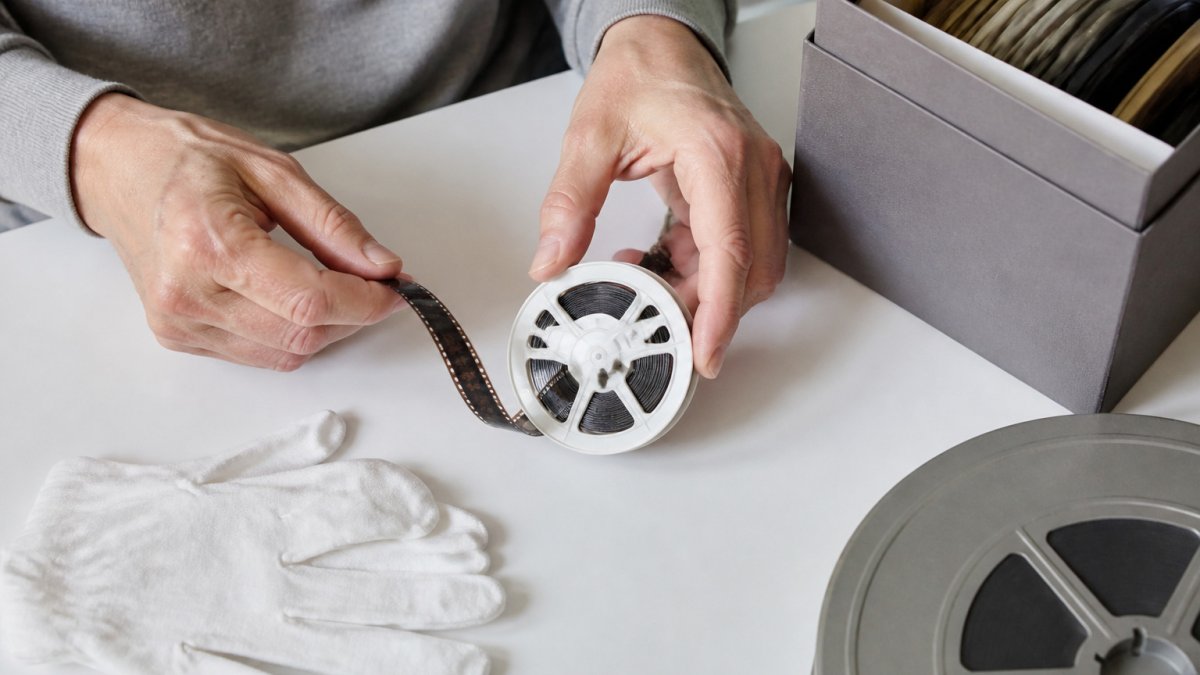
Do not attempt to repair torn or brittle film yourself with tape or glue, as this often makes later professional repair harder.
Before shipping, make a list of every reel with its label, and keep a copy for yourself. Ask the provider whether they need anything else, such as a separate order sheet or a request for specific output resolution.
Booking Your Film Reel Transfer With Showbiz Video Productions
Choosing a provider comes down to evidence: clear answers on equipment, transparent quotes, documented handling, and a realistic timeline.
When you are ready, request a quote from Showbiz Video Productions to discuss your reels, formats, and preferred output. Our team can also talk you through whether a professional transfer suits your collection, so you can weigh that decision with confidence.
Frequently Asked Questions
How do I choose a reliable film reel digitizing company?
Start by asking how the company handles original reels, including whether they inspect film for damage and how reels are stored during the job. Ask them to describe their scanning or transfer equipment in specific terms. Ask for written terms covering loss or damage, and confirm how files are delivered. A reliable provider answers these questions directly and gives a clear written quote.
