
Table of Contents
- Why You Need a Filmcopycentre Alternative
- VHS to Digital Conversion Services: What to Expect
- VHS Digitising Cost: Comparing Service Options
- DIY VHS Digitising Versus Professional Service
- Supported Formats and Delivery Options
- Video Backup External Drive: Protecting Your Digital Files
- How to Choose the Right Service for Your Needs
- Frequently Asked Questions
Last Updated: October 6, 2026
Why You Need a Filmcopycentre Alternative
Finding the right filmcopycentre alternatives matters for families with aging home video collections. Equipment that plays VHS tapes, film reels, and cassettes is increasingly hard to find, and the media itself degrades over time. At Showbiz Video Productions, we understand that choosing between DIY conversion and professional services requires weighing cost, quality, and convenience.
Digitisation options have expanded significantly, so you’re no longer limited to a single local service or expensive mail-in operations. This guide covers the key options, what to expect from each, and how to choose the right service for your budget and comfort level.
VHS to Digital Conversion Services: What to Expect
Professional VHS to digital conversion services transfer your tapes to modern formats using specialised equipment that reads the analogue signal and encodes it as a digital file. Mail-in services typically take several weeks, though some local providers are faster.
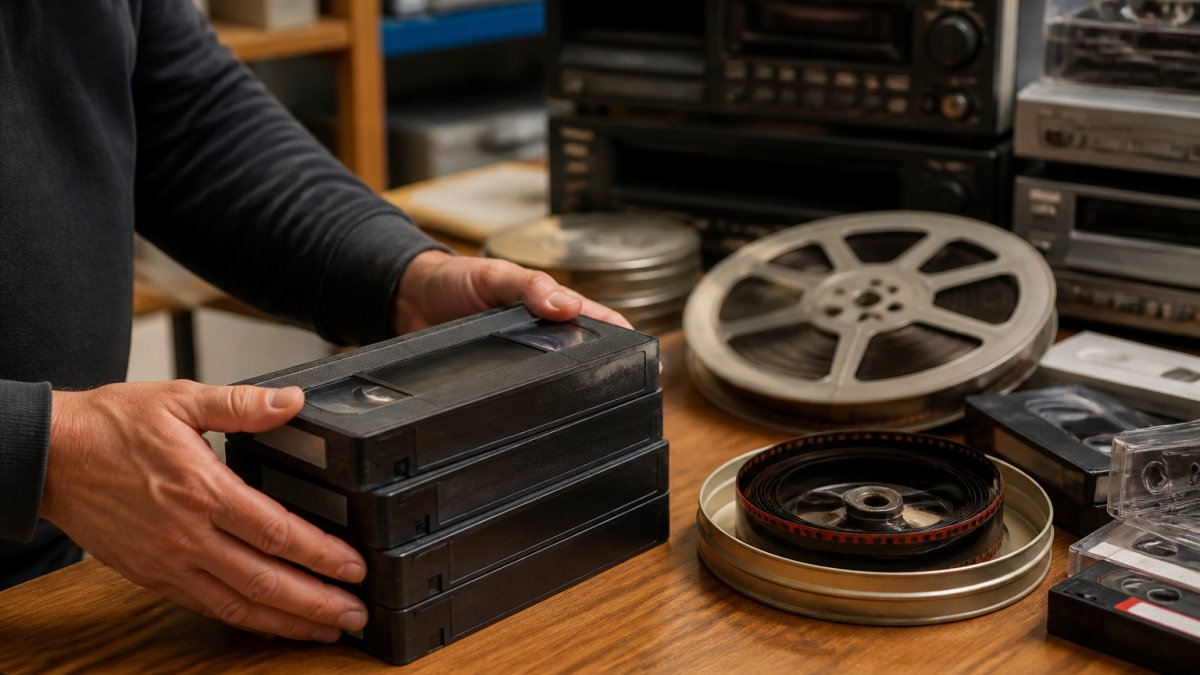
Most services deliver digitised videos on USB drives, DVDs, or cloud storage links, and some include basic restoration like noise reduction or colour correction.
Ask about equipment specifications, since professional-grade capture devices produce noticeably better results than consumer-level converters. Also confirm what happens to your originals after conversion, reputable services return or securely destroy them per your preference, and that chain of custody matters with irreplaceable memories.
VHS Digitising Cost: Comparing Service Options
Cost is where most comparisons fall apart, because services advertise a headline per-tape rate and bury the rest. Build a total-cost figure for your actual collection rather than comparing single-tape prices.
The cost components to price separately
- Per-item conversion fee, charged per tape, per reel or per cassette. A two-hour VHS and a three-minute Super 8 reel are different jobs, so ask whether the rate is flat or time-based.
- Minimum order, some providers won’t accept a single tape, or apply a small-order surcharge. Others have no minimum at all.
- Restoration and enhancement add-ons, colour correction, audio cleanup, de-interlacing, frame-by-frame repair and mould remediation are usually billed on top of the base rate, not included.
- Delivery media, a USB drive, an external hard drive or a set of DVDs may each carry a separate charge, and cloud download may be free or tiered by file size.
- Shipping both ways, mail-in services typically charge inbound shipping, outbound shipping, or both, plus insurance if you declare a value on irreplaceable originals.
- Rush or priority handling, expedited turnaround is almost always a paid upgrade.
- Re-processing or additional copies, ordering a second USB or a re-export later is a separate transaction at most providers.
A worked example of the mechanics
Say you have 20 VHS tapes averaging two hours each. A flat per-tape quote is simply 20 × rate, plus delivery media and shipping. A per-hour quote is 40 hours × rate, which can be dramatically more expensive for long-play tapes recorded in EP/SLP mode.
Ask for a written quote that itemises every line above before you ship anything. A provider that won’t itemise is a provider that will surprise you later.
How the service models compare on total cost
| Service model | Pricing basis | Typical extras | Where the cost hides |
|---|---|---|---|
| Mail-in service | Per tape or per hour + shipping | Delivery media, insurance, rush fees | Return shipping and packaging |
| Local drop-off | Per tape, no shipping | Delivery media, restoration add-ons | Parking, travel, appointment windows |
| DIY conversion | Equipment and software upfront | Capture device, VCR, editing software, your time | Failed captures and re-buys |
| Professional local with in-house handling | Per item with options | Restoration, extra copies | Add-on restoration tiers |
Transparent pricing as a differentiator
Showbiz Video Productions offers transparent pricing with no minimum order, you only pay for what you use. That suits small collections, single reels and mixed-format boxes where a minimum order would force you to pay for capacity you don’t need.
A dated methodology note
Pricing moves with equipment costs, media availability and shipping rates, so treat any figure, including ours, as a starting point.
A rate that looks far below the market usually means one of three things: lower-grade capture equipment, restoration billed separately at a high margin, or shipping and media costs loaded onto the back end. Check all three before you commit.
DIY VHS Digitising Versus Professional Service
The choice between DIY conversion and professional service comes down to your technical comfort, available time, and how much you value your source material.
DIY works best for a few tapes and technical hobbyists: you keep complete control and can experiment with restoration settings. The downside is the learning curve, video capture and file management aren’t intuitive for most people. For poor-condition tapes or damaged reels, professional equipment and expertise become invaluable.
Professional services eliminate the technical barriers and equipment investment. Trained technicians can often recover footage from damaged or degraded tapes that consumer equipment cannot read, handling fragile media without further damage.
The real difference between DIY and professional service isn’t just quality, it’s risk. Your original tapes are irreplaceable, and DIY damage is permanent. Professional services carry insurance and protocols to protect your materials, so if something goes wrong, you have recourse.
Supported Formats and Delivery Options
Digitisation services support varying formats, and this matters more than many people realise. Common formats include VHS, VHS-C, Hi8, Video8, Digital8, and film gauges like 8mm and Super 8.
When evaluating filmcopycentre alternatives, confirm that your specific media formats are supported. Ask whether the service has experience with your particular tape type and what happens if they encounter something they can’t process. Showbiz Video Productions handles VHS, film reels, cassettes, and vinyl.
Delivery options affect how you access your digitised memories. USB drives are the most flexible; DVDs suit physical-media fans but are less common on modern devices; cloud storage is convenient but raises privacy questions; external hard drives offer large capacity for extensive collections.
Ask about file formats too. MP4 is the most widely compatible, though some services deliver MOV, AVI, or other formats.
Video Backup External Drive: Protecting Your Digital Files
Once your memories are digitised, protecting those files becomes the priority. A video backup external drive is essential, since digital files are vulnerable to hard drive failure, accidental deletion, and device loss. The “3-2-1 backup rule” is industry standard: three copies, on two media types, with one offsite.
Your first copy should be the master file from your digitisation service, stored somewhere safe and not on your daily device. A second copy on an external hard drive at home gives quick access and protection against device failure.
For a typical family video collection, a 1-2TB drive is sufficient and affordable; Seagate, Western Digital, and LaCie offer reliable options.
Treat cloud storage as a supplementary backup, not a primary solution. Google Drive, Dropbox, or iCloud provide offsite protection, but require uploading large video files and trusting a third party with your family memories.
How to Choose the Right Service for Your Needs
Most guides tell you to ‘check reviews and compare prices’, true but useless. What separates providers is how they handle your originals, what they guarantee about the output, and what happens if something goes wrong.
1. Chain of custody and privacy
Your tapes are irreplaceable and your footage is private. Ask, in writing:
- How are originals logged on arrival, is each tape individually labelled and tracked against your order?
- Who physically handles the media, and is it handled in-house or subcontracted?
- Where are the digitised files stored during processing, and are they encrypted?
- When are working copies deleted, and can you request deletion in writing?
- Are originals returned by default, or destroyed on request?
A provider that answers these precisely runs a real process; a vague one is improvising.
2. Quality standards and deliverable specifications
‘Digitised’ is not a specification. Before you commit, confirm:
- Resolution and frame rate, standard-definition capture at the source’s native resolution, or upscaled? Upscaling adds no real detail and can soften the image.
- File format, MP4 (H.264) is the most broadly compatible for sharing; some providers also supply a higher-bitrate master such as MOV or ProRes for archival.
- Archival master versus sharing copy, the ideal deliverable is a high-quality master you keep untouched plus compressed copies for everyday viewing. Ask whether both are included or whether the master costs extra.
- Restoration scope, is it automated noise reduction, or manual colour correction and audio repair? These are very different products at very different price points.
The single best question to ask is: ‘Will I receive an archival master as well as a viewing copy, and in what format?’ The answer tells you whether the provider understands preservation or is just exporting files.
3. Risk, insurance and damaged-media handling
This is the criterion almost no comparison covers, and it matters most. Ask:
- What is the provider’s policy if a tape is lost or further damaged in their care?
- Do they carry insurance covering customer media, and what is the claims process?
- Do they assess condition before conversion and tell you what they found?
- What are their limits on repair, will they attempt a mould-affected or brittle tape, or decline it?
- Do they charge for a failed conversion, or only for successful output?
Fragile media, mould, splice failures, stretched tape, vinegar syndrome, needs a provider who assesses first and quotes honestly, not one who promises every tape will convert.
4. Turnaround and convenience trade-offs
Realistic timelines differ enormously by model:
- Local drop-off with in-house handling, often the fastest, because there is no shipping leg and no queue behind a national mail backlog. Appointment or drop-off windows apply.
- Mail-in, add shipping time in both directions to the processing time, plus the risk of transit damage.
- DIY, ‘immediate’ only if the equipment works first time; realistically, expect several hours per tape including capture, file management and troubleshooting.
Ask whether the provider offers order tracking or status updates, and whether you can collect in person rather than waiting on a courier.
5. Format-specific experience
A provider with hundreds of VHS reviews may have converted very few Super 8 reels or Digital8 cassettes. Ask how many jobs of your specific format they complete monthly, and what equipment they use.
Putting the scorecard together
Score each shortlisted provider against the five criteria, weighting risk and quality standards most heavily if your collection is irreplaceable.
Run a single-tape trial with any provider before handing over your entire collection. One tape tells you more about their quality, communication and turnaround than any review page.
Frequently Asked Questions
What is the best service to digitise VHS tapes?
The best VHS digitisation service depends on your priorities: speed, format variety, and budget. Professional services with over 20 years’ experience and professional-grade equipment handle degraded tapes reliably. Look for providers offering same-day or next-day turnaround, transparent pricing, and support for multiple formats including VHS and film reels. Verify they deliver high-quality digital files on USB and provide secure handling of irreplaceable media.
Is it better to digitise VHS tapes yourself or use a professional service?
DIY digitisation suits small collections and tight budgets but requires equipment investment (capture device, software, external storage). Professional services are faster, safer for degraded media, and deliver higher quality. For family heirlooms or damaged tapes, professional handling protects irreplaceable footage. If you have dozens of tapes, professional services save weeks of work and eliminate technical troubleshooting. Budget-conscious households with smaller collections may find DIY viable; larger collections justify professional conversion.
How should I back up digitised videos?
Store digitised videos on at least two separate external drives kept in different locations to prevent total loss from hardware failure or disaster. Use USB 3.0 or faster external drives rated for long-term storage. Create a master copy on one drive and a working copy on another for daily access. Consider cloud backup as a third layer for critical family footage. Check file integrity annually and refresh storage media every 5-7 years, as hard drives degrade over time. Label all drives clearly with content and dates.
What formats can professional digitisation services handle?
Reputable services convert VHS, VHS-C, 8mm and Super 8 film, audio cassettes, vinyl records. Verify the service supports your specific format before sending media. Some services handle damaged or degraded tapes better than others; services with over 20 years of experience have seen many format variations. Always ask about format compatibility upfront.
Preserving your family’s video history is one of those tasks that’s easy to postpone but important to complete. The longer you wait, the more your original media degrades. Showbiz Video Productions makes it straightforward: professional-grade digitisation, transparent pricing starting at just $6, and same-day service for most jobs. Get a quote today and take the first step toward protecting your irreplaceable memories for future generations.