
Table of Contents
- VHS to Digital Conversion: What You Need to Know
- Key Factors When Choosing a VHS to Digital Conversion Service
- Cost to Convert Old Home Videos
- VHS to USB Conversion Service: What to Expect
- How to Digitise Old Video Tapes: Step-by-Step
- Professional Service vs. DIY Conversion
- Tape Degradation and When to Act
- Conclusion
Last Updated: August 23, 2026
VHS to Digital Conversion: What You Need to Know
Converting old VHS tapes to digital format has become essential for families wanting to preserve irreplaceable memories. Whether your collection sits in a cupboard gathering dust or you’re actively worried about tape degradation, understanding your conversion options is the first step toward safeguarding those recordings.
A VHS to digital conversion transforms magnetic tape recordings into modern digital files that play on contemporary devices. The process involves reading the analogue signal from your tape using specialised equipment, then encoding it into a digital format like MP4 or storing it on USB. This matters because VHS tapes deteriorate over time, the magnetic coating flakes off, mould develops, and playback equipment becomes increasingly rare. Without conversion, you risk losing footage permanently.
At Showbiz Video Productions, we’ve been handling this exact challenge for over 20 years. The difference between a rushed conversion and a proper one shows immediately in picture quality, colour accuracy, and whether your files actually work when you need them. This guide covers what separates a reliable service from a risky one, how much you should expect to pay, and the specific steps involved in getting your tapes safely converted.
Key Factors When Choosing a VHS to Digital Conversion Service
Not all conversion services are equal. Some rush through the process and deliver blurry, colour-shifted files. Others charge premium prices while outsourcing the work to overseas facilities where your irreplaceable family videos sit in warehouses for weeks. The best services combine professional-grade equipment, transparent pricing, and genuine care for your media.
Turnaround Time and Service Speed
Speed matters when you’re entrusting irreplaceable family recordings to someone else. Most professional services quote 5-10 business days, but some offer expedited options.
Same-day or next-day turnaround is possible, but only if the service has in-house equipment and doesn’t outsource. When a facility promises same-day conversion, they’re typically handling smaller batches or running multiple shifts. Showbiz Video Productions delivers same-day service on most jobs because the entire operation, inspection, digitisation, and file encoding, happens on-site. That speed matters when you’re anxious about your tapes being out of your hands.
The tradeoff with faster turnaround is usually batch size. If you’re converting 50 tapes, expect 2-3 weeks even at a fast facility. If you’re converting 3 tapes, same-day is realistic. Always clarify whether the quoted timeframe applies to your specific job size.
Output Formats and Digital Quality
Your conversion is only useful if you can actually play the files. Different services offer different output options, and this directly affects how you’ll access your memories.
Common formats include MP4 (plays on virtually any device), USB flash drives (convenient but prone to failure over decades), DVD (outdated but familiar), and cloud storage (accessible from anywhere but dependent on internet connection). The best services let you choose your output. Some even provide multiple copies, a USB drive for immediate viewing, a backup drive for safety, and cloud backup for redundancy.
Resolution matters too. Standard VHS converts to roughly 720×480 pixels (NTSC) or 720×576 pixels (PAL) (itu.int). Some services offer upscaling to 1080p using AI enhancement, which can sharpen the image but won’t recover detail that wasn’t there originally. Ask whether the service includes basic colour correction and noise reduction as standard, or if those are paid upgrades.
Tape Condition Assessment and Handling
Before conversion begins, a reputable service should inspect your tapes for damage. Mould, warping, tape breakage, and oxide shedding (where the magnetic coating flakes off) all affect whether a tape can be safely converted.
Many services won’t tell you upfront what they found until after they’ve charged you. The best approach is to ask for a pre-conversion assessment. Showbiz Video Productions inspects every tape and communicates any concerns before starting work. If a tape is severely degraded, a good service will either warn you that recovery may be partial or recommend professional tape restoration beforehand.
Some tapes can be cleaned and repaired before conversion, which costs extra but dramatically improves results. Others are too far gone and may not convert at all. Knowing this in advance saves disappointment and money.
Cost to Convert Old Home Videos
Pricing for VHS to digital conversion varies widely depending on tape length, output format, and service location. Understanding the pricing structure helps you avoid surprises.
Most services charge per tape rather than per hour of footage. Pricing depends on several factors. Tape length matters: a 2-hour tape costs the same as a 30-minute tape at most services, though some charge by duration. Output format affects cost: USB or digital file is standard, but DVD or cloud storage may add to the cost. Bulk discounts often apply, converting 20 tapes usually costs less per tape than converting 2. Turnaround speed also influences price: same-day service typically costs more than standard 5-10 day service.
Hidden costs emerge at some services. Tape cleaning, repair, colour correction, and multiple output formats are sometimes add-ons rather than included services. Always ask for a full quote that specifies what’s included and what costs extra.
Showbiz Video Productions offers transparent, affordable pricing starting at just $6 per tape, with no hidden fees. The exact cost depends on your specific needs, so requesting a quote ensures you know the full price before committing.
VHS to USB Conversion Service: What to Expect
A VHS to USB conversion service is the most practical option for most people. USB drives are reliable, portable, and compatible with modern devices.
When you send tapes to a conversion service, expect this process: the facility receives and logs your media, inspects each tape, cleans if necessary, digitises using professional equipment, encodes the file in your chosen format, transfers it to a USB drive, and ships everything back to you. The entire process typically takes 5-15 business days depending on service speed and current workload.
Quality conversion requires more than plugging a VHS player into a computer. Professional services use dedicated digitisation hardware that captures the video signal at high precision, then apply deinterlacing (converting interlaced video to progressive frames) and colour correction. The difference between a DIY conversion and a professional one is immediately visible in sharpness, colour accuracy, and whether artefacts or distortion appear during playback.
USB output is ideal because it’s future-proof compared to DVD (which can degrade) and more reliable than cloud storage (which depends on internet access and company survival). A USB drive stored properly lasts 10-20 years, giving you time to migrate files again if needed (peer-reviewed research).
How to Digitise Old Video Tapes: Step-by-Step
Converting your tapes involves several stages, from preparation through storage. Understanding each step helps you avoid mistakes and ensures the best possible outcome.
Preparing Your Tapes for Conversion
Before shipping your tapes anywhere, inspect them carefully. Look for visible damage: broken cases, cracked spools, mould (white or black spots), warping, or tape protruding from the case. If a tape is severely damaged, mention it when you contact the service, they need to know what they’re working with.
Rewind all tapes to the beginning. This prevents the tape from being under tension and reduces the risk of breakage during playback. If a tape has been sitting for years, gently fast-forward and rewind it a few times to loosen the oxide coating and reduce shedding during conversion.
Label each tape clearly with the date recorded, location, and any people featured. This helps the service keep track of your media and makes it easier to organise your files afterward. Take photos of the original tape labels in case information is important later.
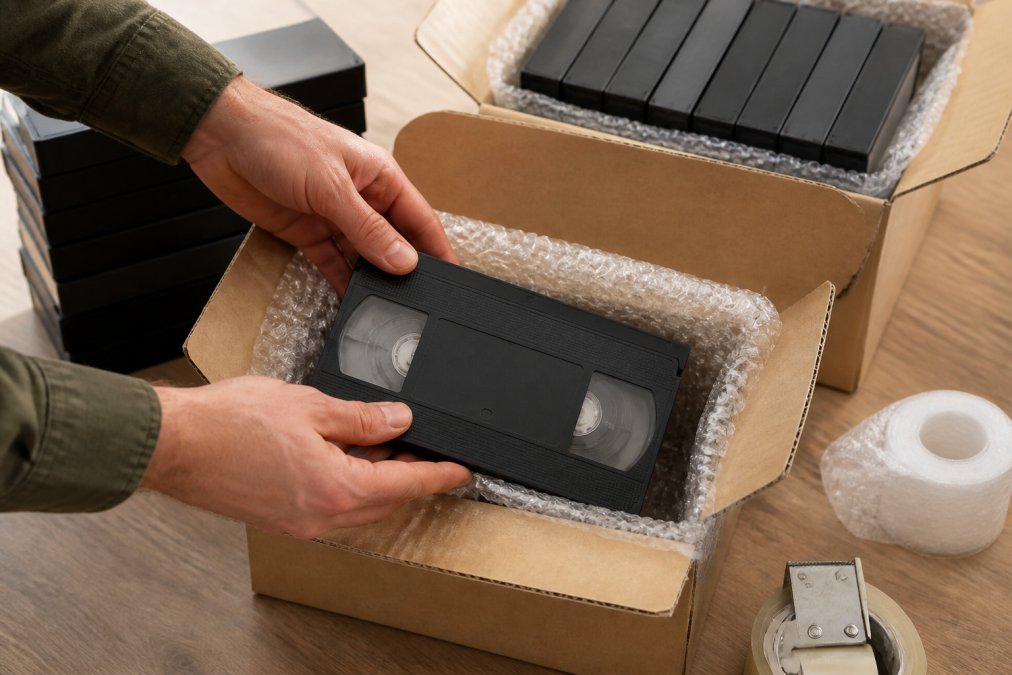
Shipping and Security Considerations
Shipping irreplaceable family videos requires care. Use a sturdy box with padding, bubble wrap, foam, or crumpled paper work well. Never ship loose tapes; they’ll shift during transit and risk damage. Include a packing list describing each tape so the service can verify everything arrived intact.
Consider insured shipping. Most courier services offer declared value coverage, which protects your tapes if they’re lost or damaged in transit. The cost is modest and worth the peace of mind.
Ask the service about their security and handling procedures. Reputable facilities keep tapes in climate-controlled storage, handle them with care, and maintain confidentiality. Some services provide tracking so you can see when your tapes arrive and when conversion is complete.
Post-Conversion File Management and Storage
Once your files arrive, you need a storage strategy. Don’t rely on a single USB drive, drives fail, and a single point of failure means losing everything. The best approach is the 3-2-1 backup rule: keep 3 copies of your files, on 2 different types of media, with 1 copy stored offsite.
For example: one copy on your computer’s hard drive, one on an external USB drive, and one in cloud storage (Google Drive, OneDrive, or similar). This protects against drive failure, accidental deletion, and house fire or theft. Update your backups annually to ensure you’re not relying on aging hardware.
Organise your files logically from day one. Create folders by year, location, or family member. Rename files from generic names like "VHS_001.mp4" to something descriptive like "Christmas_1998_Brisbane.mp4". This takes an hour now and saves hours later when you’re searching for a specific memory.
Professional Service vs. DIY Conversion
The choice between hiring a professional and doing it yourself depends on your technical comfort, equipment access, and how much your tapes mean to you.
DIY conversion requires purchasing or renting a VCR with composite or S-video output, a video capture device (typically $30-$150), and software for encoding. You’ll also need a computer with sufficient storage and processing power. The actual conversion process is straightforward, connect the VCR to the capture device, press play, and record, but quality varies wildly. Most DIY setups produce noticeably softer, more colour-shifted video than professional equipment.
The real risk with DIY is tape handling. If your VCR is old or poorly maintained, it can damage tapes during playback. Once a tape is damaged, professional recovery becomes expensive or impossible. For tapes recorded 20+ years ago that you haven’t touched since, the risk isn’t worth the savings.
Professional services use industrial-grade equipment that handles aged tapes more gently and captures video at higher precision. They also have experience identifying tape problems before they cause damage. For family videos, the cost is worth the security of knowing your memories are safe.
Tape Degradation and When to Act
VHS tapes don’t last forever. The magnetic coating degrades, especially in warm, humid environments. Understanding the warning signs helps you prioritise which tapes to convert first.
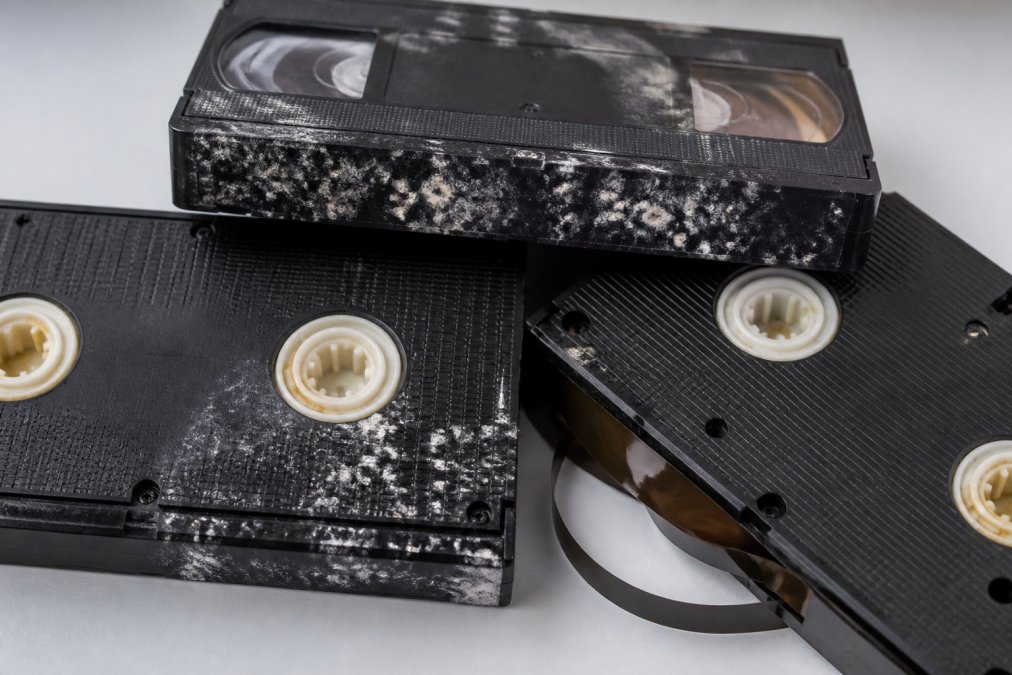
Mould is the most visible sign of trouble. If you see white, black, or green spots on the tape, case, or inside the cassette, the tape has been exposed to moisture. Mould can spread to other tapes nearby, so isolate affected ones immediately. Some mould can be cleaned off before conversion, but severe cases may be unrecoverable.
Tape warping, where the plastic case or the tape itself has bent or twisted, usually means the tape was stored in a hot environment. Warped tapes often won’t play at all because they jam inside the player. If a tape is warped, don’t try to force it into a VCR; take it directly to a professional who can assess whether it’s salvageable.
Oxide shedding is harder to spot but equally serious. If you’ve played a tape recently and noticed the VCR’s heads getting dirty (requiring frequent cleaning), that’s a sign the magnetic coating is flaking off. Once shedding starts, each playback makes it worse. If you suspect oxide shedding, stop playing the tape and convert it professionally.
Colour shift, where the video looks unusually red, blue, or faded, indicates the tape’s colour information is degrading. This is often irreversible, but professional conversion can sometimes restore some colour balance through correction algorithms.
The timeline matters. Tapes recorded in the 1980s and early 1990s are now 30+ years old (loc.gov). Many are reaching the end of their lifespan. If you have tapes you haven’t watched in years, prioritise converting them soon. Every year you wait increases the risk that the tape will become unplayable before you can digitise it.
=== FAQ ANSWERS (audit these too, same rules) ===
[1] Q: How much does it cost to convert a VHS tape to digital?
A: The cost to convert old home videos varies based on tape quantity, condition, desired output format, and turnaround time. Most professional services charge per tape, with pricing depending on whether you need USB, DVD, or cloud storage options. For precise pricing tailored to your collection, contact a service provider directly to discuss your specific needs and receive a transparent quote.
[2] Q: What is the typical turnaround time for professional VHS digitisation?
A: Turnaround times range from same-day service for small jobs to several weeks for large collections or heavily degraded tapes. Services offering express turnaround typically prioritise your order but may charge a premium. Standard turnaround is usually 5-10 business days. Check with your chosen provider about their current timeframes, as these depend on current workload and tape condition assessment.
[3] Q: Is it better to use a professional service or a DIY converter for VHS to USB conversion?
A: Professional VHS to USB conversion services use professional-grade equipment and expertise to handle tape degradation, tracking issues, and video signal problems that DIY converters cannot address. Professionals deliver archival-quality digital files with proper codec settings and bitrate optimisation. DIY options are cheaper but risk damaging irreplaceable tapes and produce lower resolution output. For sentimental or heavily used tapes, professional conversion is the safer choice.
[4] Q: What formats will my videos be in after conversion?
A: Most professional services deliver conversions in MP4 format, which plays on modern devices, TVs, and computers without compatibility issues. Some also offer DVD output for traditional playback or cloud storage uploads for easy sharing. Ask your provider about their default codec, resolution (720p or 1080p), and whether they offer multiple format options. Ensure the output format suits your playback needs and long-term archival plans.
[5] Q: Can a professional service convert damaged or mouldy VHS tapes?
A: Many professional services can recover footage from tapes showing early signs of degradation, mould, or tracking issues using advanced equipment and restoration techniques. However, severely deteriorated tapes may not yield usable video. Professional technicians assess tape condition before conversion and can advise whether recovery is possible. Early action is critical, tape degradation accelerates over time, so contact a service if you suspect your collection is at risk.
Frequently Asked Questions
How much does it cost to convert a VHS tape to digital?
The cost to convert old home videos varies based on tape quantity, condition, desired output format, and turnaround time. Most professional services charge per tape, with pricing depending on whether you need USB, DVD, or cloud storage options. For precise pricing tailored to your collection, contact a service provider directly to discuss your specific needs and receive a transparent quote.
What is the typical turnaround time for professional VHS digitisation?
Turnaround times range from same-day service for small jobs to several weeks for large collections or heavily degraded tapes. Services offering express turnaround typically prioritise your order but may charge a premium. Standard turnaround is usually 5-10 business days. Check with your chosen provider about their current timeframes, as these depend on current workload and tape condition assessment.
Is it better to use a professional service or a DIY converter for VHS to USB conversion?
Professional VHS to USB conversion services use professional-grade equipment and expertise to handle tape degradation, tracking issues, and video signal problems that DIY converters cannot address. Professionals deliver archival-quality digital files with proper codec settings and bitrate optimisation. DIY options are cheaper but risk damaging irreplaceable tapes and produce lower resolution output. For sentimental or heavily used tapes, professional conversion is the safer choice.
What formats will my videos be in after conversion?
Most professional services deliver conversions in MP4 format, which plays on modern devices, TVs, and computers without compatibility issues. Some also offer DVD output for traditional playback or cloud storage uploads for easy sharing. Ask your provider about their default codec, resolution (720p or 1080p), and whether they offer multiple format options. Ensure the output format suits your playback needs and long-term archival plans.
Can a professional service convert damaged or mouldy VHS tapes?
Many professional services can recover footage from tapes showing early signs of degradation, mould, or tracking issues using advanced equipment and restoration techniques. However, severely deteriorated tapes may not yield usable video. Professional technicians assess tape condition before conversion and can advise whether recovery is possible. Early action is critical, tape degradation accelerates over time, so contact a service if you suspect your collection is at risk.
Preserving your family’s video memories requires acting before it’s too late. Tape degradation accelerates once it starts, and some damage is irreversible. Showbiz Video Productions handles the conversion process with professional-grade equipment and over 20 years of experience, ensuring your precious recordings are digitised safely and stored in formats that will remain accessible for decades. Get a quote today and protect your memories for future generations.
This article was written using GrandRanker