
Table of Contents
- How to Choose a Media Digitisation Service
- Supported Media Formats: What Each Service Accepts
- VHS to Digital Conversion Cost: Pricing Comparison
- Turnaround Time for Video Conversion: Speed and Reliability
- Service Delivery Options: Drop-Off, Mail-In, and Same-Day Processing
- Quality Assurance and File Format Standards
- Security and Handling of Original Media
- DIY vs Professional Digitisation: When to Use Each Approach
Last Updated: August 22, 2026
How to Choose a Media Digitisation Service
Choosing between VideoRescue and local conversion services comes down to understanding what each can deliver and where your priorities lie. The decision isn’t just about price, it’s about turnaround time, format support, handling standards, and whether you need same-day service or can wait for mail-in processing.
Both options exist to solve the same core problem: your irreplaceable home movies, VHS tapes, film reels, and vinyl records are degrading. Equipment to play them no longer exists. You need professional-grade digitisation to preserve these memories before it’s too late.
The real question is which service model fits your situation. Are you in a hurry? Do you have rare or damaged media? Are you working with a tight budget? Your answers determine whether a local service or a mail-in alternative makes sense.
What formats can they handle?
Media digitisation services differ significantly in the formats they accept. Some specialise in common formats like VHS and MiniDV, while others handle the full spectrum including Super 8 film, Betamax, Hi8, 35mm slides, and vinyl records.
Showbiz Video Productions handles an extensive range: VHS, film reels, cassettes, and vinyl. This breadth matters because most families don’t have just one format sitting in the attic. You’ve got VHS from the 90s, maybe some 8mm film reels from the 80s, and perhaps vinyl records from even further back. A service that forces you to go to multiple providers wastes time and money.
Local conversion services vary widely. Some are generalists covering most common formats. Others specialise, one might focus on film restoration while another handles only video formats. Before committing, verify the specific formats they accept. Ask directly: "Can you handle MiniDV? Hi8? Super 8?" Don’t assume.
Quality and equipment standards
This is where professional services separate from casual operations. Professional-grade equipment isn’t just marketing speak, it determines whether your digitised files are archival quality or merely watchable.
Real professional equipment uses multi-step colour correction, frame-by-frame restoration, and high-resolution capture. Budget operations use consumer-grade equipment that produces adequate results but misses the detail and longevity of archival-quality files.
Ask any service about their equipment specifications. What resolution do they capture at? Do they use colour correction? How do they handle damaged or warped media? A service using professional-grade equipment will answer these questions directly. Vague answers suggest consumer-level gear.
Supported Media Formats: What Each Service Accepts
The formats you need converted determine which service can actually help you. VideoRescue and local alternatives have different coverage areas, and getting this wrong means a wasted trip or a returned box of unusable media.
Common formats most services handle:
- VHS and VHS-C
- MiniDV and Digital8
- Hi8 and 8mm video
- Betamax and U-matic
- Super 8 film
- 35mm slides and negatives
- Vinyl records
- Cassette tapes
Showbiz Video Productions accepts VHS, film reels, cassettes, and vinyl, covering the formats most families actually have. This is the practical sweet spot. You won’t need to split your collection between providers.
Local services often specialise. One might excel at film restoration but handle video only as a side service. Another might focus exclusively on VHS conversion. Before choosing, list every format you own and verify the service handles all of them. A service that accepts 80% of your collection still leaves you with a problem for the remaining 20%.
The gap between what services advertise and what they actually process well is real. Some accept Betamax "in theory" but rarely see it and produce mediocre results. Others have invested in proper equipment for rare formats and deliver exceptional quality. Ask: "How often do you process this format? What does your quality control look like for it?"
VHS to Digital Conversion Cost: Pricing Comparison
Pricing structures differ between VideoRescue and local conversion services, and understanding the model matters as much as the headline price.
Showbiz Video Productions offers transparent, affordable pricing starting at $6 per item (bbb.org). This straightforward per-item model means you pay only for what you convert. Pricing depends on quantity, dates, and delivery. No hidden minimums, no surprise charges.
Local services vary. Some use per-item pricing similar to Showbiz Video Productions. Others charge by the hour, which introduces uncertainty, a damaged tape might take longer, pushing your cost up unexpectedly. Some offer package deals: "Convert 10 tapes for $80" or similar bundles.
The real cost comparison depends on your volume and urgency. If you have 15 tapes and can wait two weeks, a mail-in service with lower per-item rates might save money. If you need same-day turnaround for five tapes, a local drop-off service might justify a higher per-item cost through convenience and speed.
Request a quote from any service before committing. Provide the exact formats and quantities you have. Ask whether they charge for damaged media the same as pristine media, some services do, others adjust pricing based on restoration work required.
One often-overlooked cost is delivery. Mail-in services typically cover postage both ways, but verify this. Some charge for return shipping or require you to pay for insurance on irreplaceable originals. Local services eliminate shipping costs but require your time to drop off and pick up.
Turnaround Time for Video Conversion: Speed and Reliability
Turnaround time ranges from same-day to several weeks, and this dramatically affects your experience.
Showbiz Video Productions offers same-day service in most cases. This means you can drop off tapes in the morning and collect digital files by evening. For people nervous about handing over irreplaceable media, same-day turnaround minimises anxiety. You’re not leaving originals in someone’s possession for weeks.
Local services vary. Some offer next-day turnaround for small jobs. Others work on a queue system: drop off on Monday, collect Friday. Mail-in services typically take 2-3 weeks from the moment they receive your media until files are returned (aarp.org).
The turnaround time you need depends on your situation. If you’re digitising for a specific event, a family gathering, an anniversary gift, fast turnaround matters. If you’re simply preserving family history with no deadline, slower services are fine and may offer better value.
Ask services about their typical turnaround for your specific formats. VHS turnaround is usually faster than film restoration because the equipment is more standardised. Ask also about their queue: do they prioritise based on when you drop off, or do they batch similar formats together?
One critical question: what happens if media is damaged or unreadable? Does the turnaround clock extend? A reliable service will tell you upfront: "If we encounter damage, we’ll contact you within X days to discuss options."
Service Delivery Options: Drop-Off, Mail-In, and Same-Day Processing
How you get media to the service and receive files back shapes the entire experience.
Drop-off services require you to visit a physical location. You hand over tapes, discuss your needs, and either wait for same-day results or return later. This works well if the service is nearby and you’re available during business hours. It eliminates shipping risks and gives you face-to-face reassurance about how your media will be handled.
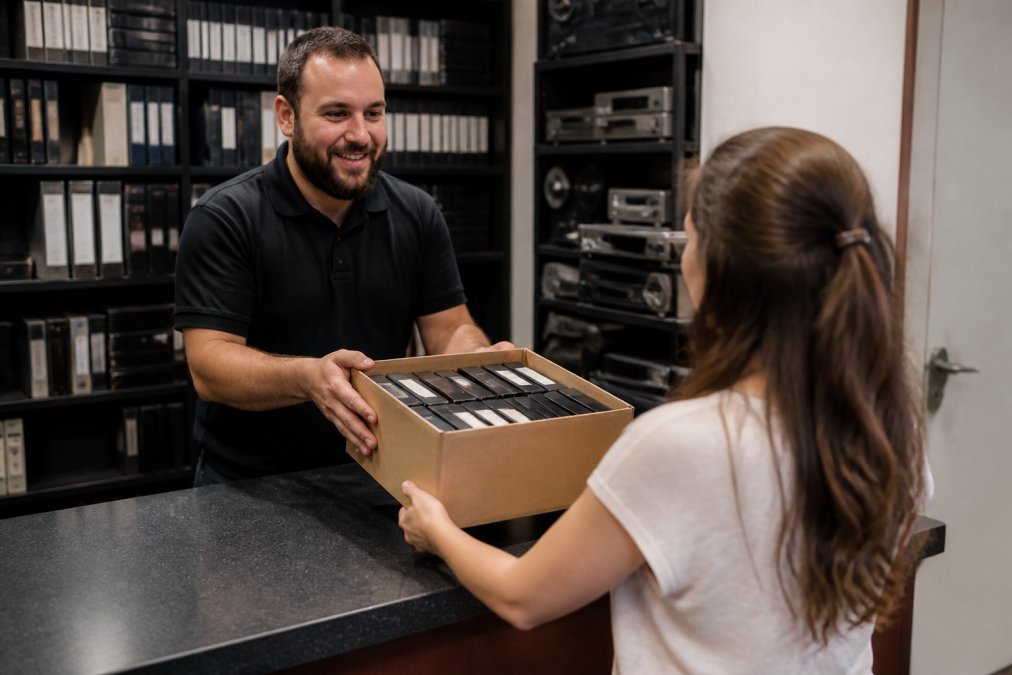
Mail-in services send you a prepaid box, you fill it with media, and they process it while it’s in transit. You receive digital files back via download link or physical storage device. This works for people without local services or those with large collections. The downside: your originals are in transit for days, and you have no control over handling during shipping.
Same-day processing is Showbiz Video Productions’ competitive advantage. Drop off in the morning, collect files by evening. This eliminates the anxiety of leaving irreplaceable media with a service for weeks.
Local services typically offer drop-off with standard turnaround (2-7 days). Some offer expedited processing for additional cost. Mail-in alternatives offer convenience at the cost of speed and handling visibility.
Your choice depends on geography, urgency, and comfort level. If you’re within driving distance of a same-day service, that option reduces risk and stress. If you’re rural or prefer not to leave home, mail-in is the trade-off you accept.
Quality Assurance and File Format Standards
What you receive back matters as much as how fast you get it. Quality assurance and file format standards determine whether your digitised files remain accessible and watchable for decades.
Professional services use quality assurance protocols: colour correction, frame-by-frame inspection for damage, audio level normalisation. They deliver files in standard formats like MP4, which play on any modern device without special software. They also provide options for archival-quality formats like ProRes or uncompressed video if you want preservation-grade files.
Ask any service: what file formats do you deliver? MP4 is universal. MOV works on Apple devices. AVI is older but still readable. Avoid services that deliver proprietary formats or formats you’ve never heard of, these risk becoming unreadable as technology evolves.
Ask also about resolution. Standard definition VHS digitises to 720×480 or similar (smpte.org). Hi8 captures at higher resolution. Film reels can be scanned at 2K or 4K resolution depending on the original quality and the service’s equipment. Higher resolution captures more detail but creates larger files.
Archival quality matters if you’re preserving for future generations. Compressed MP4 files are fine for watching on a TV. Uncompressed or lightly compressed formats preserve maximum detail but require more storage space. Showbiz Video Productions delivers high-quality digital formats suitable for modern playback and long-term preservation.
Local services vary. Some deliver only compressed MP4. Others offer multiple format options. Specify your needs: "I want files I can watch immediately on my TV, plus a backup copy on an external hard drive."
Security and Handling of Original Media
Your originals are irreplaceable. How a service handles them during the digitisation process determines whether they come back intact or damaged.
Professional services use climate-controlled storage, handle media with clean hands or gloves, and keep detailed records of what’s in their possession. They use gentle playback equipment designed to minimise wear. They never force stuck tapes or reels, if media is damaged or degraded, they stop and contact you rather than risk further damage.
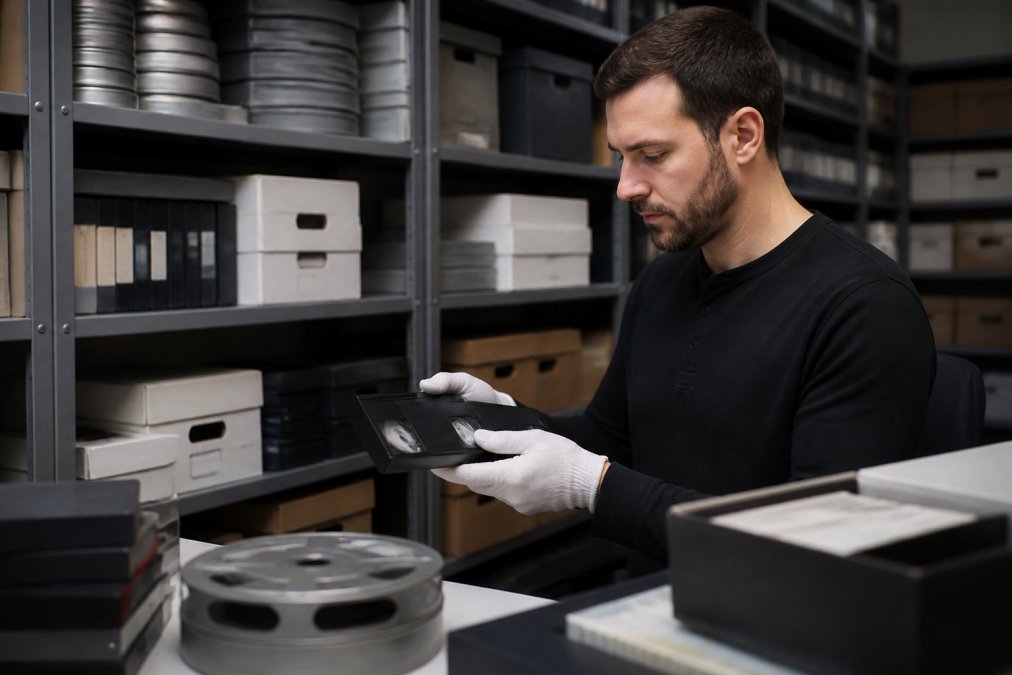
Ask any service: how do you store media while processing? Are your facilities climate-controlled? What happens if a tape is stuck or damaged? Do you keep an inventory of what’s in your possession?
Insurance is also important. Some services include basic insurance in their fees. Others require you to declare the value of your originals and offer optional insurance. Understand what’s covered: is it the original media, the digitised files, or both? What’s the claim process if something goes wrong?
Showbiz Video Productions handles media with professional care, using expert-grade equipment and secure handling protocols. This isn’t just reassuring, it’s essential when you’re handing over the only copy of your child’s first birthday or your parents’ wedding video.
Local services vary widely. Some are meticulous. Others are careless. Visit the facility if possible. Ask to see where your media will be stored. Look for climate control, organised shelving, and clean work areas. If a service seems disorganised or dismissive about handling concerns, find another option.
DIY vs Professional Digitisation: When to Use Each Approach
You could digitise media yourself using consumer equipment. The question is whether you should.
DIY digitisation means buying or renting playback equipment (a VCR, film projector, turntable) and capturing video or audio through your computer or camera. The appeal is cost, you might spend $100-200 on equipment rather than $100-300 on professional services. The reality is more complicated.
Consumer equipment produces lower-quality captures. A VCR connected to a computer via composite cables captures at standard definition with colour shifts and audio sync issues. Film projectors pointed at a camera produce uneven lighting and poor colour reproduction. Turntables connected to audio interfaces introduce noise and distortion.
DIY also requires technical knowledge. You need to understand video codecs, audio levels, file formats, and storage. You need patience to process dozens of tapes individually. You need backup systems to avoid losing digitised files to hard drive failure.
DIY works if you have one or two tapes and don’t mind imperfect results. It fails if you have a large collection, rare formats, or damaged media.
Professional digitisation uses equipment specifically designed for media transfer. Dedicated VCR players capture at higher resolution with colour correction. Film scanners handle delicate reels without manual handling. Turntable preamps reduce noise and distortion. Technicians know how to handle damaged media without destroying it further.
The cost difference between DIY and professional narrows when you factor in your time, failed attempts, and the risk of losing files. Professional services also provide archival-quality files and long-term storage options.
Choose professional services if you have more than five tapes, if media is damaged or rare, or if you want results you can trust. Choose DIY only if you have minimal media, technical confidence, and accept lower quality.
Showbiz Video Productions makes professional digitisation accessible through affordable, transparent pricing and same-day service. For most families, this removes the DIY complexity entirely.
=== FAQ ANSWERS (audit these too, same rules) ===
[1] Q: What should I look for when choosing a local media digitisation service?
A: Prioritise services that handle your specific formats, VHS, MiniDV, Hi8, Super 8 film, or 35mm slides. Verify they use professional-grade equipment for archival-quality output, offer secure handling with documented chain of custody, and provide transparent turnaround times. Check customer reviews and ask about their in-house technicians’ experience. Confirm the file formats they deliver (MP4, MOV) are compatible with your devices, and ensure they offer a clear pricing structure without hidden fees.
[2] Q: How much does VHS to digital conversion typically cost?
A: Costs vary based on quantity, format complexity, and delivery speed. Local digitisation services often charge per item or offer package rates for bulk orders. Pricing depends on whether you choose standard or expedited turnaround, drop-off or mail-in service, and the quality level (standard or restoration). Visit your chosen provider’s pricing page for current rates, or request a quote based on your specific collection size and format mix.
[3] Q: Can professional services really recover old or degraded VHS tapes?
A: Yes, professional digitisation services use specialised equipment designed to read legacy media formats even when they show signs of degradation. Technicians can often recover content from tapes with mould, warping, or tracking issues that consumer equipment cannot process. However, severely damaged originals may have limited recoverable content. Professional services assess condition before processing and communicate realistic expectations about what can be salvaged from your specific tapes.
[4] Q: What’s the typical turnaround time for video conversion?
A: Turnaround times range from same-day service for small orders to several weeks for large collections. Local providers often offer expedited options, same-day or next-day processing for rush jobs, though standard service typically takes 5-10 business days. Mail-in services may add 3-5 days for shipping. Confirm turnaround expectations upfront, especially if you need digitisation completed by a specific date for a family event or gift.
Frequently Asked Questions
What should I look for when choosing a local media digitisation service?
Prioritise services that handle your specific formats, VHS, MiniDV, Hi8, Super 8 film, or 35mm slides. Verify they use professional-grade equipment for archival-quality output, offer secure handling with documented chain of custody, and provide transparent turnaround times. Check customer reviews and ask about their in-house technicians' experience. Confirm the file formats they deliver (MP4, MOV) are compatible with your devices, and ensure they offer a clear pricing structure without hidden fees.
How much does VHS to digital conversion typically cost?
Costs vary based on quantity, format complexity, and delivery speed. Local digitisation services often charge per item or offer package rates for bulk orders. Pricing depends on whether you choose standard or expedited turnaround, drop-off or mail-in service, and the quality level (standard or restoration). Visit your chosen provider's pricing page for current rates, or request a quote based on your specific collection size and format mix.
Can professional services really recover old or degraded VHS tapes?
Yes, professional digitisation services use specialised equipment designed to read legacy media formats even when they show signs of degradation. Technicians can often recover content from tapes with mould, warping, or tracking issues that consumer equipment cannot process. However, severely damaged originals may have limited recoverable content. Professional services assess condition before processing and communicate realistic expectations about what can be salvaged from your specific tapes.
What's the typical turnaround time for video conversion?
Turnaround times range from same-day service for small orders to several weeks for large collections. Local providers often offer expedited options, same-day or next-day processing for rush jobs, though standard service typically takes 5-10 business days. Mail-in services may add 3-5 days for shipping. Confirm turnaround expectations upfront, especially if you need digitisation completed by a specific date for a family event or gift.
Preserving family memories is too important to leave to chance. Whether you choose a mail-in service or a same-day local option, prioritise professional handling, transparent pricing, and formats you can actually use. Showbiz Video Productions combines all three: professional-grade equipment, affordable pricing starting at $6 per item, and same-day turnaround in most cases. Get a quote and protect your family’s history before it’s too late.
This article was written using GrandRanker