Table of Contents
- Digital Conversion vs Physical Tape Storage: The Core Comparison
- The Real Lifespan of Magnetic Tape vs Digital Files
- What a VHS to Digital Conversion Service Actually Does
- Cost, Air-Gapped Security and Ransomware Protection
- When Physical Tape Still Makes Sense: LTO and Cold Storage
- A Hybrid Workflow for Home Collections
- Conclusion
- Frequently Asked Questions
Last Updated: September 12, 2026
Digital Conversion vs Physical Tape Storage: The Core Comparison
Digital conversion and physical tape storage solve two different problems: access and endurance. Converting a VHS tape to a digital file makes it instantly watchable and shareable, while tape storage remains one of the most durable and cost-effective mediums for long-term archival. For most households, the honest answer is that you need both, and this guide from Showbiz Video Productions breaks down exactly where each approach wins.
The comparison matters because the stakes are higher than most people realise. Tape degrades quietly, and digital files can decay just as silently through bit rot. Below, we’ll show you how each storage type actually behaves over decades, what a professional VHS to digital conversion service does that a DIY setup cannot, and how to build a hybrid workflow that protects a family collection for good.
Digital conversion solves access. Tape storage solves longevity. Neither replaces the other, and treating them as competitors is the most common mistake in this decision.
Sequential Access vs Random Access Explained
Sequential access means the system must read through everything before the target data, like fast-forwarding a cassette to reach one song. Random access means it can jump straight to any point, which is how a hard drive or SSD retrieves a file in milliseconds.
That single distinction explains most of the practical difference between tape and digital. LTO tape reads and writes data in long sequential streams, which is why it achieves enormous capacity at low cost but carries high latency for individual file retrieval. Disk and flash storage offer low latency and instant random access, which suits everyday playback but costs far more per terabyte at scale.
| Attribute | Magnetic Tape (LTO) | Digital Files (Disk/SSD/Cloud) |
|---|---|---|
| Access method | Sequential | Random |
| Retrieval latency | High | Low |
| Cost per terabyte | Very low | Higher |
| Best for | Cold archival | Daily access and sharing |
| Ransomware exposure | Low when air-gapped | Higher when networked |
The Real Lifespan of Magnetic Tape vs Digital Files
The lifespan of magnetic tape depends heavily on storage conditions, but manufacturers typically rate LTO media for around 30 years when kept in controlled temperature and humidity. Digital files have no fixed expiry, yet the drives, formats, and software needed to read them often fail long before the data itself does.
That asymmetry is the crux. A tape in a cool, dry cabinet can outlast three generations of hard drives. A digital file copied faithfully every few years can outlast the tape. The risk sits in the gap: files left on a single aging drive, or tapes stored in a hot garage, both fail silently.
- Magnetic tape: rated for decades under stable conditions, vulnerable to heat, humidity, and stray magnetic fields
- Hard drives: mechanical parts wear out, typical service life measured in years of active use
- SSDs: no moving parts, but charge retention in unpowered cells is finite
- Optical discs: variable quality, with many consumer-burned discs degrading faster than expected
Bit Rot and Data Integrity Verification
Bit rot is the gradual, undetected corruption of digital data over time, where individual bits flip and a file quietly becomes unreadable. It is the digital equivalent of tape dropouts, and it is why verification matters as much as storage.
The defence is a checksum workflow. Generate a hash value for each file at the moment of capture, store that hash alongside the file, and re-run the check periodically. If the hash changes, the file has degraded and must be restored from another copy. This is standard practice in enterprise archiving and almost entirely absent from home collections.
The most common mistake is the “one copy” archive: a single external drive holding the only digital version of a family collection. When that drive fails, and it will, there is no checksum record and no second copy to restore from. Always keep at least two verified copies in separate locations.
What a VHS to Digital Conversion Service Actually Does
A professional VHS to digital conversion service captures analogue video through broadcast-grade time base correction, cleans the signal, and encodes it to a modern digital format. The difference between this and a cheap capture card is not marketing language, it is the hardware that stabilises a worn tape before the signal ever reaches the encoder.
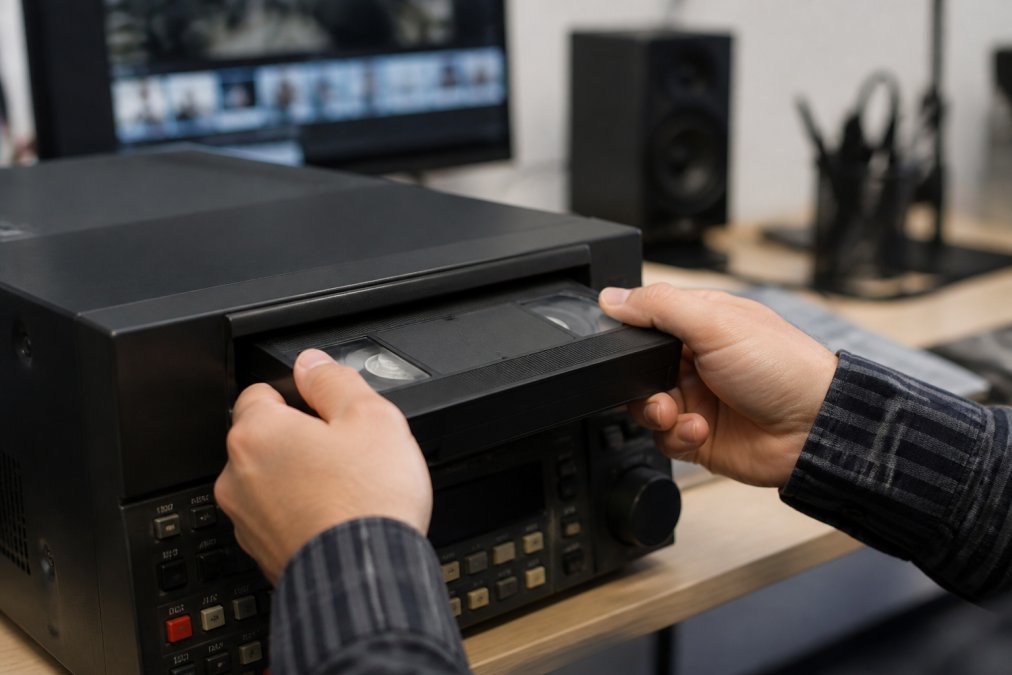
Here is what the process looks like end to end:
- Inspection and cleaning of each tape or film reel
- Playback on a calibrated deck with time base correction
- Capture to a lossless master file
- Encoding to a shareable format such as MP4
- Delivery on USB, download, or both, with a checksum record
For anyone with a mix of VHS, 8mm film reels, cassettes, and vinyl, a single service that handles all formats removes the biggest logistical headache. Showbiz Video Productions covers that full spread, with same-day turnaround in most cases and no job considered too small.
Cost, Air-Gapped Security and Ransomware Protection
Air-gapped storage means the medium is physically disconnected from any network, which is why tape remains a cornerstone of ransomware protection. An attacker who encrypts every connected drive cannot reach a cartridge sitting in a cabinet or an off-site vault. The mechanism is simple: no network path, no attack surface. Cloud storage, by contrast, is always reachable by design, and even with strong access controls, a compromised credential is enough to expose the data.
This is where tape’s economics become compelling. LTO media has historically delivered the lowest cost per terabyte of any storage medium at scale, and the total cost of ownership improves the longer you keep the data because the media itself is cheap to replace and the drive is a one-time capital cost. Cloud storage inverts that: low upfront cost, but a recurring subscription that compounds every year. Over a ten-year horizon, the crossover point where tape becomes cheaper than cloud is typically reached within the first few years for large cold archives.
For a household, the calculus is simpler. A digitised collection on two drives covers daily access and sharing. A tape or offline drive copy adds the air-gapped layer that survives a ransomware event, a flood, or a house move gone wrong. The cost of an LTO drive is hard to justify for a single family collection, but the cost of a high-capacity external drive stored offline is trivial, and it delivers most of the same protection.
There is an environmental dimension that most comparisons ignore. Always-on cloud storage consumes energy continuously, servers, cooling, networking, and that footprint scales with the number of copies and the frequency of access (energy.gov). Tape and offline drives consume almost nothing when idle. For an organisation with ESG targets, or a household trying to reduce its digital footprint, cold storage on physical media is the lower-energy option for data that does not need to be online. Reusing existing drives and cartridges rather than streaming everything from always-on servers reduces the energy footprint of a personal archive. Long-term preservation and lower environmental impact are not in conflict here, they point the same way.
- Air-gapped tape or offline drives: immune to network-based ransomware, near-zero idle energy draw
- Cloud storage: convenient and accessible, but always reachable and continuously powered
- Cost per terabyte: tape lowest at scale, cloud lowest for small active datasets
- Environmental impact: cold physical media has a far lower idle energy footprint than always-on cloud
A common mistake is storing tapes or backup drives in a garage or shed. Heat and humidity are the two fastest killers of magnetic media. A cool, dark, dry cupboard inside the house will outlast any “secure” outdoor storage.
When Physical Tape Still Makes Sense: LTO and Cold Storage
Physical tape still makes sense for cold storage: data that must be preserved for years but rarely retrieved. LTO (Linear Tape-Open) cartridges hold enormous capacity per unit, are designed for write-once-read-many workflows, and are built for long-term preservation in a way consumer drives are not.
Enterprise data centres have relied on this for decades, and the logic scales down. A virtual tape library (VTL) presents tape storage through disk-based interfaces, blending tape’s economics with disk’s speed (techtarget.com). For individuals, the practical equivalent is a high-capacity external drive stored offline, rotated periodically, and verified with checksums.
- Choose LTO or offline drives when: the data is archival, rarely accessed, and must survive a decade or more
- Choose cloud or networked storage when: the data needs frequent access and sharing
- Choose digitisation when: the source is analogue and the playback equipment no longer exists
A common mistake is storing tapes or backup drives in a garage or shed. Heat and humidity are the two fastest killers of magnetic media. A cool, dark, dry cupboard inside the house will outlast any “secure” outdoor storage.
A Hybrid Workflow for Home Collections
A hybrid workflow pairs digitisation for access with physical storage for endurance. Digitise the analogue originals once, verify the files, then keep two copies: one online for daily use, one offline and air-gapped for preservation.
The environmental angle is worth noting too. Reusing existing drives and cartridges, rather than streaming everything from always-on cloud servers, reduces the energy footprint of a personal archive. Long-term preservation and lower environmental impact are not in conflict here, they point the same way.
| Stage | Action | Frequency |
|---|---|---|
| Convert | Digitise VHS, film, and audio via a professional service | Once |
| Verify | Generate and store checksums for every file | At capture |
| Access copy | Keep on a networked drive or cloud for sharing | Continuous |
| Archive copy | Store on offline drive or tape, air-gapped | Rotate yearly |
| Integrity check | Re-run checksums against the stored hashes | Every 12 months |
Conclusion
The real challenge is not choosing between digital conversion and physical tape storage, it is building a workflow that uses each for what it does best before the originals degrade any further. Showbiz Video Productions has spent over 20 years converting VHS, film reels, cassettes, and vinyl into high-quality digital files, with professional-grade equipment, same-day turnaround in most cases, and transparent pricing that starts affordably. Get a quote from Showbiz Video Productions and give your family’s memories a preservation plan that lasts for generations.
Frequently Asked Questions
What are the disadvantages of tape storage for home collections?
Magnetic tape degrades over time, and the lifespan of magnetic tape depends heavily on storage conditions. Heat, humidity and mould accelerate breakdown, and playback equipment for formats like VHS is increasingly hard to find. Tape also uses sequential access, so finding one clip means winding through the whole reel. For irreplaceable family footage, those combined risks make digital conversion the safer long-term option.
What is the 3/2/1 rule for storing family memories?
The 3/2/1 rule means keeping three copies of your media, on two different storage types, with one copy stored off-site. A practical setup is a digital file on your computer, a second copy on an external drive, and a third in cloud storage or at another address. This protects against drive failure, fire, theft and accidental deletion, which no single tape or disc can do on its own.
Is LTO tape better than a hard drive for long-term archiving?
For cold storage, LTO tape wins on cost per terabyte and shelf life, and it can be kept air-gapped so ransomware cannot reach it. Hard drives offer faster random access and simpler retrieval, but they need power, periodic checks and replacement every few years. For large archives accessed rarely, tape is cheaper over time; for everyday access, a drive is more convenient.
Does digital conversion maintain the original quality of my video tapes?
A professional VHS to digital conversion service captures the tape at its best possible playback quality using calibrated equipment, so the digital file reflects what the tape still holds. It cannot restore detail already lost to wear or mould. Files are delivered in modern formats that play on current devices, which is a major improvement over hunting down a working VCR.
Is tape storage still used anywhere today?
Yes. Tape storage remains common in data centres, broadcast archives and research institutions because of its low cost per terabyte, long shelf life and air-gapped security. LTO cartridges and virtual tape libraries handle large-scale data archival and disaster recovery. Consumer use has faded, but the technology itself is still actively developed and supported.